
What FLIBS 2026 Might Reveal About the Future of Boating


The Fort Lauderdale International Boat Show kicks off at the end of this month. The entirety of the recreational marine industry will be gathering to see the latest tech, explore the latest trends in manufacturing, and see how firsthand how others are navigating shifting consumer expectations. For boaters, it will be the clearest glimpse of what 2027 will hold, both in the short term and the long term, for recreational boating. Given the current rate of change, it's possible 2027 will mark the beginning of a technological renaissance.
Consumer expectations are driving five emerging trends: smarter technology, integrated electrical systems, connected safety, multifunctional boats, and the migration of advanced features into smaller vessels.
Manufacturers are responding to shifting consumer expectations while having to balance the economic pressures shaping the market.
What will that look like at FLIBS? Let's discuss:
1. Boats are getting smarter. Integrated electronics are becoming not only normalized, but expected.

What does it mean to say a boat is getting 'smarter'? By and large, it means the boat is doing more of the labour, diagnostic work, and physical operation that used to be the responsibility of captain and crew.
As smart technology advances, boat owners increasingly expect their new vessel to handle a larger percentage of these tasks.
Autonomous technology is starting to take over one major task: docking. Modern systems combine GPS, cameras, radar, sonar and onboard computing to interpret a constantly changing environment and make corrections in real time. The technology has advanced quickly from assisting captains with joystick controls while docking, to integrated systems that are capable of recognizing unfamiliar marinas, planning a route, and handling docking and undocking with little or no operator input.
Brunswick proved it was possible in 2023. Brett Dibkey, Brunswick Corp executive vice president and division president of Navico Group at the time, said: “We’re on a journey with autonomy, and auto docking is the first step in that journey. This provides the framework for the integration of all of the technology that we have in our portfolio, from radar and GPS and sonar, plus the full integration with Mercury engines, to really transform the entire boating experience from end to end...That thousand mile journey begins with a single step, and this is more of a giant leap.”
The same sensors that enable autonomous manoeuvring also monitor the boat itself. Engine load, operating hours, and system data can identify maintenance requirements before a failure occurs. This is quickly blurring the line between an operator's responsibilities and the responsibility of diagnostic systems to guard the vessel.
The smartphone is another link in that emerging network. Mobile apps can already combine navigation, engine monitoring, vessel location, battery status, bilge monitoring, geofencing, security alerts, maintenance records, and service information in a single interface. Much, if not all, of this responsibility fell to the owner as little as a decade ago.
Historically, the captain has been the central processor for a boat: information arrives through gauges, electronics, or physical observation, and the captain interprets it. This is quickly changing to the boat collecting and processing that information before presenting it to the operator.
Now, don't get it wrong: the captain still runs the boat. But, the boat is increasingly gathering, interpreting, and presenting its own information, rather than captain or crew having to do it manually. That is what separates today’s connected systems from vessels of 10-20 years ago: what they can do with the information they collect from multiple systems at the same time.
2. Electrical systems are becoming more sophisticated. Power management is increasingly becoming a major part of boat design.
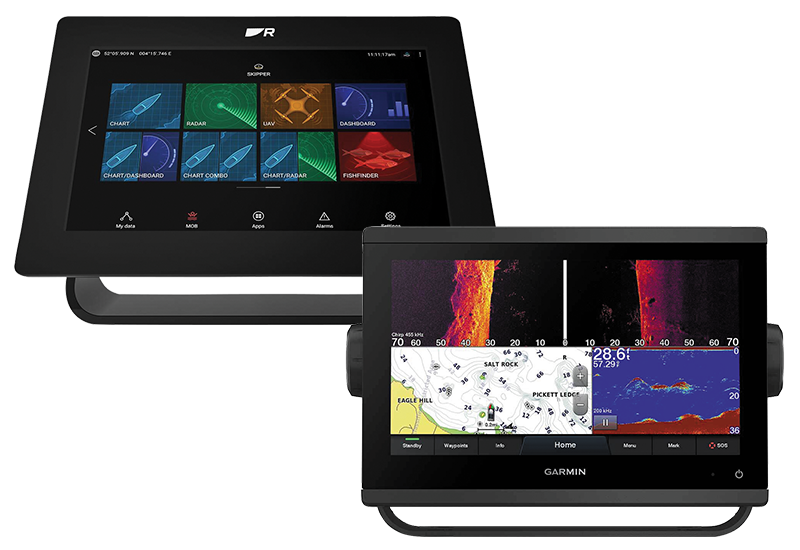
The move toward connected boats has an overlooked consequence: the electrical system is becoming the backbone of the boat.
Modern boats are no longer using electricity simply for lights, pumps, and stereos. Electrical power increasingly supports propulsion, navigation, communications, digital switching, security, entertainment, and the networks connecting them. As more systems depend on an electrical network, power management becomes a key part of a boat's architecture.
Just as the horsepower wars forced manufacturers to rethink hull design, transom strength, and weight distribution, increasingly sophisticated electronics are pushing them to reconsider how electrical infrastructure is integrated into a boat.
The 2026 IBEX Innovation Awards illustrate the shift. Egis Mobile Electric won an award for their Modular Power Distribution Module—a modular unit that consolidates switches, fuse blocks, and bus bars, to turn a boat's electrical system into an integrated, networked environment.
There is another consequence to this transition: electrical infrastructure increasingly has to be designed with software in mind. As electrical tech becomes the backbone of a boat, an electrical fault is no longer necessarily isolated to a single device. The boat's ability to distribute power, communicate between systems, and identify faults becomes part of the overall ownership experience.
In other words, the electrical system is becoming less like the wiring in a house and more like the network infrastructure in a modern vehicle. This also has safety and security considerations, too.
3. Safety is becoming connected

Canyon Runner won the Safety Equipment category at the 2026 IBEX Innovation Awards.
Their system, called the BRIZO Connected Vessel Intelligence Service, combines live vessel data, predictive analysis, weather intelligence, navigation information, and crowdsourced data to give captains a more complete set of information for making decisions on the water.
There is an important distinction here. Connected safety is not necessarily about adding another piece of equipment to the boat. It is about combining information that already exists, or can be collected, and making it useful to the captain operating the vessel.
Canyon Runner's system provides a glimpse into the future of that approach.

Its Virtual Captain vessel-management system uses real-time information about weather, sea conditions, and other operating factors to guide the captain towards the best maneuver or position to take. Viam, which worked with Canyon Runner on the system, says data from different onboard sources was consolidated into an interface accessible through a web application and mobile app.
The system was also designed to work with existing marine electronics rather than requiring boat owners to replace their equipment. That is significant because it removes one of the biggest barriers to connected technology: the assumption that adopting new capabilities requires rebuilding the entire boat's electronics package.
Canyon Runner's system also demonstrates how connected safety can extend beyond a single vessel. The company's previous telematics system collected information from a limited number of boats and relied heavily on manual communication. The new system was designed to collect and distribute information across a much larger fleet.
This marks a broader change from reactive safety to information-based safety.
A traditional safety system responds to a problem: an alarm sounds, a bilge pump activates, a weather warning is issued, or a captain notices a developing hazard. Connected systems combine multiple pieces of information before and during an event to offer solutions prior to a situation reaching a critical status.
Now, this does not remove the captain from the equation. It simply gives the captain more information with which to make a decision.
Thanks to this push in integrated safety systems, that information can come from multiple boats, weather services, navigation systems, and onboard sensors. That gives the captain a safety picture beyond what is only happening on their vessel.
4. Boats are becoming more multifunctional

The proliferation of terms like "crossover" and "hybrid" is more than a naming trend. It reflects manufacturers designing boats around the number of activities a single owner can perform with them. This is all driven by consumer expectations.

Lowe's new Crosswater Series is a straightforward example on a small scale. The new Crosswater models are designed to operate in coastal flats and marshes as well as lakes and rivers, with a design that combines a bay boat with an inland fishing boat.
"Today's boaters want versatility without compromise," said Erica Moreland, Marketing Manager for Lowe Boats. "The Crosswater was designed for people who don't want multiple specialty boats. Whether you're targeting fish at sunrise, cruising with family in the afternoon, or exploring new waterways on the weekend, Crosswater gives you one platform that can do it all."

World Cat is approaching the same problem from a different direction. Its 235HB Hybrid is designed for a host of environments. The 9" draft and low-profile gunwales are intended for shallow-water use, while the twin-hull design provides offshore capability.
"Our idea was to create a model that allows for offshore, inshore, and flats fishing capabilities, as well as cruising, diving, and skiing/watersports," said Chad Armstrong, World Cat's Director of Sales.

Formula's 360 Super Sport Crossover takes the concept into a larger and more luxury-oriented segment. The new model combines an open bow, a full-width coupe top, overnight accommodations, a galley, enclosed head, and multiple cockpit configurations. It is designed to function as both an open dayboat and an enclosed boat for overnight and weekend use.
Groupe Beneteau's 2027 product strategy illustrates the breadth of the shift. The company announced 24 new models across sailing yachts, multihulls, dayboats, and motor yachts as part of a broader plan to introduce 66 models between 2025 and 2027.
“In an uncertain market, we are not choosing to wait. We continue to invest, accelerate and act on the levers we control. Our strategy is clear: to offer the right products and the right services, from accessible boating to premium,” said Bruno Thivoyon, Chairman of the Management Board of Groupe Beneteau.
The common denominator is that the boat is no longer being defined solely by one activity.
Fishing boats are adding family and recreational features. Cruising boats are gaining watersports and entertainment capabilities. Dayboats are gaining overnight accommodations.
The result is a market increasingly organized around versatility rather than specialization.
For manufacturers, this means one boat must satisfy many use cases.
5. Advanced technology is finding its way into smaller boats

The recreational marine industry has historically introduced new technology at the top of the market and allowed it to work its way downward. What is changing is the speed at which that process can occur.
Smaller boats are becoming an increasingly important part of that equation because consumers are looking for boats that are easier to buy, tow, launch, store and operate. Recent market data shows fishing boats, personal watercraft and trailerable boats among the more resilient segments of recreational boating, while broader new-boat unit sales have faced pressure from interest rates, inflation and consumer confidence.
That creates an interesting design problem for manufacturers: how much capability can be put into a smaller package without making the boat too expensive or too complicated?
There are already signs of the answer. Right now, small boats are having a moment.
Technologies that once required dedicated hardware are increasingly being delivered through software. Navigation, engine information, battery monitoring, maintenance records, security alerts and vessel location can all be accessed through connected applications rather than separate pieces of equipment.
That matters because software can scale differently from hardware. In essence, it takes up less space.
Once the underlying connectivity, sensors, and computing architecture are established, adding that capability does not necessarily require adding another physical unit or instrument to a vessel. A system that begins by displaying engine information can eventually incorporate maintenance alerts. A navigation application can incorporate weather, AIS, and geofencing. A vessel-monitoring system can add security alerts and battery information. This doesn't require a new unit mounted on the helm and attached to the wiring harness each time.
All this emerging tech creates a path from a 40-foot boat to a 20-foot boat that did not exist even a few years ago. New capability used to require another physical unit. Now it doesn't. That means more features, options, and systems packed into a smaller boat.
Consumers will obviously like this. Manufacturers will have to find a way to deliver it.
Expect to see this playing out at FLIBS. Read more: Small boats, big appeal: why smaller boats are having a moment #culture


Comments