
Horsepower Wars - How the Marine Industry Keeps Raising the Bar

Updated: Jul 1

It wasn't that long ago that a 250 horsepower outboard represented the upper limit of recreational marine propulsion. We were glad to have it.
The late '70s and early '80s got us close courtesy of Mercury and Yamaha breaking into the 200-235 range, but the first truly common 250 hp outboard was OMC's 3.6L V8 in 1985. By the time the early '90s hit, factory speeds exceeding 60 mph were normalized. Boaters were not upset about it. Who wouldn't want to go faster? We became accustomed to what is now considered "mid-range" power.
It was all we needed... or so we thought.
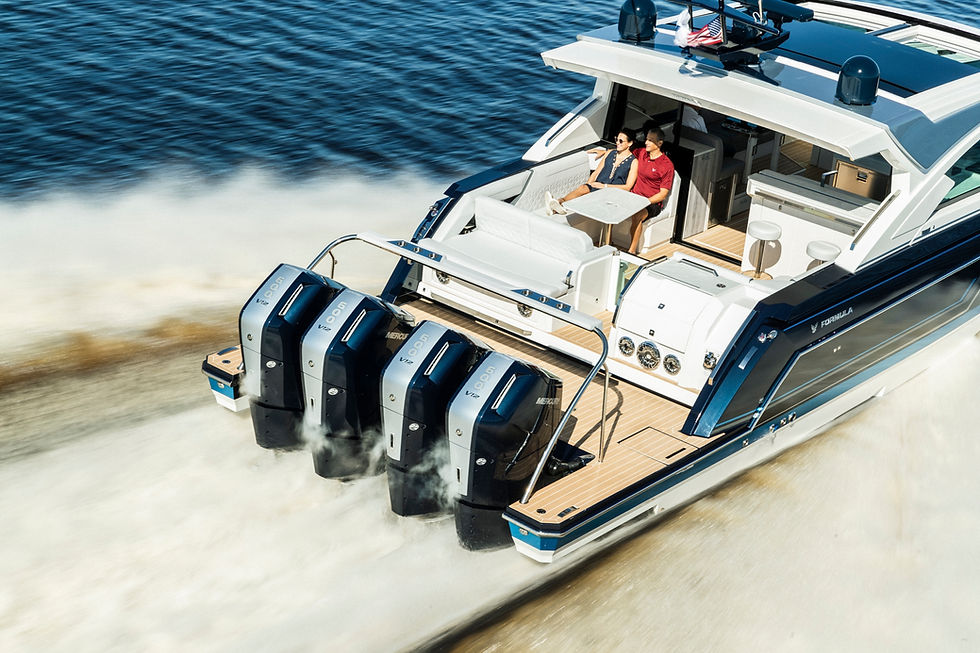
Nowadays, mid-range and higher production boats routinely leave dealerships with triple, quad, and even quintuple outboard configurations producing well over 1500 total horsepower. It's no longer uncommon to see high-performance boats packing quad, or even quint, 600s for a massive 2400 to 3000 horsepower. Fishing boats, center consoles, and performance dayboats seemingly average 300 to 800 horsepower. That's all relatively new, but no one is complaining. A single 350-600 hp outboard today easily outperforms a twin outboard configuration from 25 years ago.
Individual engines themselves have grown dramatically, with manufacturers now offering production outboards ranging from 350 to 600 horsepower with varying levels of high-end performance features. Stock boats that used to come with 75-150 horsepower as their baseline now put 125-200 on the transom. Boaters, thrill seekers that we are, do not mind the extra juice.
We've already explored whether the multi-outboard trend was justified and determined that, yes, boaters have no qualms about adding horsepower to the transom. That isn't a surprise. The surprise is the rate of change.
The increase in 'standard' horsepower isn't the result of a single breakthrough. Instead, it's a reflection of changing boat designs, advances in engine technology, and consumer demand for larger boats capable of carrying more passengers, equipment, and fuel while maintaining high cruising speeds.
It's an evolution, and it's moving at a fast pace. So where does it all lead?
The Race to Bigger Numbers
The shift toward larger outboards has accelerated over the last 25 years, but significantlywithin the last 10. While 250+ horsepower engines were once considered exceptional, manufacturers have normalized higher output as larger center consoles and luxury dayboats have taken their place in the market. And that's just on the recreational side, not the racing side. One thing at a time.
In 2017, Suzuki introduced the DF350A, which became the highest-horsepower production four-stroke outboard available at the time. The engine featured dual contra-rotating propellers and an offset driveshaft designed to improve grip and efficiency on heavier boats.
That was nine years ago.
A year later, Yamaha entered the segment with the 425-horsepower XTO Offshore, developed specifically for large offshore boats requiring increased torque and long-range reliability. In 2025, they bumped it up to the 450 XTO Offshore.
Mercury Marine raised the bar in 2021 when they introduced the 600-horsepower V12 Verado. The engine incorporated several engineering changes uncommon in traditional outboards, including a steerable gearcase with a fixed powerhead (meaning the upper powerhead does not rotate during steering), and a two-speed automatic transmission. With the fixed powerhead and rotating lower unit, multiple engines could be mounted closer together. A transom that could previously fit two engines could now fit three. Three could fit four. And so on.
In 2023, Honda entered the high-horsepower category with the BF350, meaning every major manufacturer was actively pursuing larger outboard capability. They even partnered with McLaren Engineering on a unique 300 horsepower M300 platform.
Right now, every major manufacturer has standard offerings from 350 to 600 horsepower. They're popular, too.
Bigger Boats Need Bigger Power
As you'd expect, to keep up with the tempo of technological advancement, boatbuilders needed to adapt. The surge in horsepower has been matched by an evolution in recreational boat design. This is perhaps best seen in the center console and offshore category, particularly in boats ranging from 35 to 45 feet, where brands like Pursuit, Valhalla, Cigarette, Nor-Tech, and Mystic are now offering models designed around triple, quad, or quintuple outboard setups. Even more 'recreational' or luxury-based brands like Regal, Boston Whaler, Formula, Scout, and Sea Ray all have offerings with triple 300 to 400 outboards, or twin 600s.

As these boats are becoming larger and heavier to satisfy consumer demands for versatility, the added horsepower serves more purposes than simply increasing top speed. Larger engines help boats plane more quickly, maintain cruising speeds with full fuel and passenger loads, and provide better performance in offshore conditions. Outboards also offer easier access to maintenance and repairs at the transom, making them more attractive to both dealers and buyers.
They also look pretty cool, and that matters.
For many buyers, the emphasis has shifted away from achieving maximum speed to a tighter focus on capability, cruising performance, and ease-of-use.
Engineering Has Changed Alongside Horsepower

So what came first, the chicken or the egg? Did larger engines cause larger boats, or did larger boats put pressure on engine builders to catch up? It depends on who you ask, but there's reasonable evidence to suggest that a push toward larger boats spawned the horsepower wars. Consumers are increasingly looking for an "all-in-one" boat that offers solid performance, the ability to accommodate nearly any scenario, and is easy to own and operate.
To keep up, engine manufacturers have improved electronic fuel injection systems, digital engine controls, cooling systems, and corrosion resistance. They also began incorporating stronger internal components capable of handling greater loads.
Suzuki's first dual-propeller outboard system in 2017, and Yamaha's high-displacement high-torque designs starting with the V6 Offshore platform in 2010, demonstrate that manufacturers are using different approaches to engineering while targeting the same growing segment of the market.
Mercury's V12 600 Verado launch in 2021 is arguably the prime example. Rather than enlarging an existing platform, Mercury redesigned several key systems, which included relocating steering functions to the gearcase and introducing a two-speed transmission to optimize performance across a wider operating range.

And that's to say nothing of what's to come, which will focus on software over hardware. Mercury gave us the first glimpse with Boost - a digital software update for existing engines that can improve acceleration by up to 21% without any hardware changes. More digital-based 'tuning' from manufacturers is all but certain in the future.
More Horsepower Doesn't Always Mean More Speed

Although horsepower figures continue to climb, performance depends on more than engine output alone.
Hull design, boat weight, propeller selection, gear ratios, sea conditions, and overall setup all influence how a boat performs on the water. Doubling horsepower doesn't mean doubling top speed, but it does mean improvement in overall performance with respect to acceleration, payload, planing time, cruising speed, and handling. Adding a few extra MPH doesn't hurt a boater's ego, as we know. For hardcore anglers, high-performance enthusiasts, and offshore explorers, these perks may be as valuable as reaching the highest possible top-end speed.
The Trade-Offs

It's not all sunshine and rainbows, or free gasoline and limitless gas tanks, as it were. Higher horsepower also brings additional considerations.
Larger outboards increase purchase prices and can represent a substantial portion of a boat's overall cost. As more engines go on the transom, the price tag goes up, and not by an insignificant amount. Multi-engine setups require additional maintenance, with more oil changes, gearcases, propellers, and routine service intervals compared to single-engine setups.
Weight is another factor. Larger engines out greater loads on a boat's transom, requiring boat builders to design stronger hull structures and more robust rigging systems. It's worth noting that the industry has done a superb job accommodating the horsepower wars. We're not hearing stories of failed transoms and outboards going AWOL. That's a good thing. But more weight is more weight, and it has an effect on everything from trailering to cruising range.
Fuel consumption also increases as engine output rises, particularly when operating at high speeds. It's no secret that gas prices aren't particularly encouraging for the market right now.
So What's Next?

Well, we're not slowing down. We're speeding up.
As recreational boats continue to grow in size and capability, engine builders will be expected to focus on increasing efficiency, improving reliability, and refining propulsion technology beyond the simple goal of increasing horsepower. Hybrid propulsion systems that toggle between electric and gas, alternative fuels like the Yamaha hydrogen outboard, and advances in digital engine controls are part of the broader conversation surrounding the future of marine propulsion. This is good for everyone.
So, while the definition of a "large outboard" has changed drastically in the last 25 years, we’ve gone from 350 to 600 horsepower in less than 10 years. But even with market and economic pressures seemingly bearing down, we're not taking a step back towards some fanciful “micro-outboard" era. Changes in boat design, consumer expectations, and engineering capability are all driving us forward.
In fact, we're about to break the 800 horsepower plateau:


Comments