
The Fastest Boats in the World Pt. I - The Beginning

Updated: Feb 27
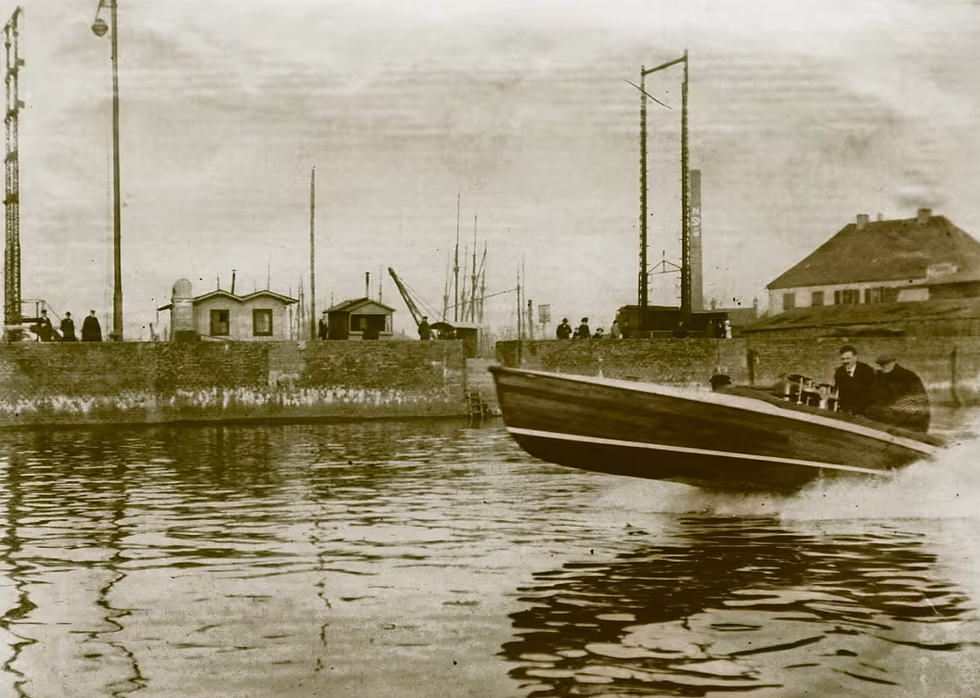
Over the next few weeks, we will determine the "Fastest Boat in the World" in each of several categories -- runabout, center console, cruiser, jet boat, pontoon boat, V-hull and multi-hull performance boats, battery-powered, personal watercraft (PWC), and several categories of race and specialty boats. But first, we need to start with a bit of background.
Yes, the title says fastest “boats” but it really should be fastest “powerboats” as it is those numbers that elicit the oohs and aahs, not to mention the ongoing arguments with your buds at your local marina. So let’s take a look at where and how record-keeping of speed on the water began. But first, a little housecleaning to set the stage.
I suppose 'speed' probably began with a dugout canoe and as soon as there were two of them, human nature being what it is, the race was on to make one faster than the other. Today, canoes, especially the longer and narrower ones, can reach maximum speeds of around 7 mph (11.3 km/h). A rowboat is roughly the same speed, while an Olympic-style rowing shell can reach up to 14 mph (23 km/h). The Men’s Eight racing shells are said to be the fastest human-powered boats on the water. A racing kayak is said to be able to reach 9 mph (14 km/h).
Sailboats are a wee bit faster. The fastest sailing ship in history is said to be the 252-foot (77-m) clipper ship Sovereign of the Seas at 22 knots, equal to 25 mph or 41 km/h. It has held this record since 1854. Now, before you start writing a whole bunch of protest letters to the editor, please read on. You are probably going to say, hold on, what about the Bluenose?

At 143 feet (44 m), the Canadian designed and built Bluenose was the fastest fishing schooner in the North Atlantic ocean. It captured the annual Fisherman’s Trophy for the 40 mile (64 km) race for 17 consecutive years in the 1920s and ‘30s – an unparalleled reign. It was known for exceptional speed in strong winds, with a top recorded speed of 16 knots, equal to 18 mph or 30 km/h, but way slower than Sovereign of the Seas. The Bluenose still lives on in the hearts of many as it has been featured since 1937 on one side of the Canadian ten-cent piece, the dime.

Without getting too deep into sailboat delineation, suffice to say that a clipper is generally much larger than a schooner and has square sails on three masts, while the generally smaller schooner has two masts but with both fore and aft sails. Note the size difference between the faster 252-foot clipper Sovereign of the Seas and the slower 143-foot schooner Bluenose. This size difference is critically important when it comes to the speed capability of a displacement hulled vessel.
And here’s why: like ocean-going freighters and cruise ships, most sailboats, and certainly the larger ones, have displacement hulls as opposed to the planing hulls of faster powerboats. A displacement hull is designed to move through the water as opposed to riding “on top” of the water when not at rest. This means that, since water is not compressible like air, the displacement hull has to move water aside as the hull moves forward in the water. That water must “fill in” the hole the vessel leaves behind as it moves forward creating said hole.
As the displacement hull moves forward, it creates both a bow wave and a stern wave of the water it is pushing aside (i.e., displacing). As the hull increases its speed as it moves forward, the bow wave is seen to exit the hull further and further aft until the bow wave actually reaches the stern wave and merges with it. This is the theoretical point of no return of speed. The hull (i.e., the vessel) cannot go any faster virtually no matter how much more power is applied. This represents the theoretical “hull speed” of a pure displacement hulled vessel.
The maximum speed of a pure displacement hull vessel can be calculated mathematically. It is 1.34 times the square root of the waterline length of the boat in feet. The answer is measured in knots. So, for a boat with a waterline length of 100 feet, its maximum speed would be 1.34 x (sq. root of 100 =10) or 13.4 knots. Since one knot equals 1.15 miles per hour or 1.85 kilometres per hour, the answer to the maximum speed of a 100-foot (at waterline) displacement hull boat is 13.4 knots, equal to 15.4 mph or 24.8 km/h.
Oh, and since the definition of one knot is "one nautical mile per hour," you never say “knots per hour.” The “per hour” is already in the definition. Oh, and one more thing, one nautical mile is the distance of one minute of latitude on the surface of the earth. There are 60 minutes of latitude in one degree of latitude, and 180 degrees of latitude between the North and South poles.
But back to speed. This calculation means that the average 30-foot pleasure sailboat with a waterline length of 25 to 27 feet would have a maximum speed of about 7 knots, or roughly 8 mph or 13 km/h. But, we know that many sailboats in that size range can be faster than that. It is because many pleasure sailboats do not have full displacement hulls, per se, but are designed to be able to plane to some degree. Other sailboats like the famous 16 or 18-foot Hobie catamaran are capable of maximum speeds of up to 24 knots or almost 28 mph or 44 km/h. Exhilarating to say the least! But, this speed is because they do not have true displacement hulls but more planing-styled hulls. But size still matters if you have a full displacement hull.
Some quick sailing stats to consider. Whereas the Union Internationale Motonautique (UIM) was created in 1922 to govern and record all powerboating racing and speed records, it wasn’t until 1972 that the World Sailing Speed Record Council (WSSRC) was created. In that same year, the 56-foot (17 m) plywood asymmetrical catamaran Crossbow set the world sailing speed record of 26.3 knots (30 mph / 49km/h). Crossbow II broke the 30 knot (35 mph / 56 km/h) barrier in 1976 and then the 36 knot (41 mph / 67 km/h) barrier in 1980.

Other forms of sailing started breaking records. Windsurfers started in the late 1980s and broke 40 knots (46 mph / 74 km/h) followed by 46 knots (53 mph / 85 km/h) in the early 2000s. Then a kiteboard broke 50 knots (58 mph / 93 km/h) in 2008, and 56 knots (64 mph / 104 km/h) in 2010 -- the current record. Meanwhile, a trimaran hydrofoil hit 51 knots (59 mph / 94 km/h) in 2009, setting a new record for “normal” sailboats. A super-ventilated foil Vestas Sailrocket 2 established the current sailing speed record of 65 knots (75 mph / 120 km/h) in 2012. Recent America’s Cup foiling monohull sailboats can reach 55 knots (63 mph / 102 km/h) or more.
Okay, enough sailing. Let’s start our powerboating speed record history. Obviously that didn’t start until someone put an engine into a boat and called it a powerboat. That someone was arguably James Watt, the Scottish inventor erroneously credited with the invention of the steam engine. Somewhere in the late 1700s he placed one such steam engine into a boat in Birmingham, England and voila -- the creation of the powerboat. In 1788, Patrick Miller achieved 5 mph (8 km/h) in Scotland powered by steam. In 1790, John Fitch achieved 8 mph (13 km/h) in a steam-powered boat on the Delaware River.

The internal combustion engine (ICE) was slowly developing in the late 1700s and the French were credited with the first ICE-powered boat in the early 1800s. The first accredited motorboat -- a double-ender skiff named Rems -- had been commissioned by German inventors Gottlieb Daimler and Wilhelm Maybach from Friedrich Lursson, founder of what is today Lursson Yachts. In 1886, Daimler and Maybach installed their one cylinder, one horsepower, half-litre displacement ICE into Rems, which took credit as the first motorboat even though Watt had done it 100 years earlier.

By the turn of the 20th century, both pleasure and commercial motorboating was growing exponentially, both in Europe and America. And of course, where there are motors, there are those wanting to race them. In 1902, the Marine Motoring Association was founded in England, followed the next year in the United States by the American Power Boat Association (APBA), both with the objective to create unified rules for boat racing by delineating classes of boats and their engines. In that same year, the French formed its Congress of Automobile Boats and created a 60-mile circuit race on the River Seine, a 230-mile marathon out of Paris, and the following year, a race across the English Channel.

Also in 1903, British newspaper magnate Sir Alfred Harmsworth donated the Harmsworth Cup, arguably the world’s oldest and most famous powerboat racing trophy, for international powerboat competition. There were few rules, but the boat and engine had to be designed and built in the country being represented. The first race for the Harmsworth trophy was won by the 40-foot Napier I, designed and built as a race boat by Napier and Company of England and driven by Dorothy Levitt. The hull was steel and the four-cylinder Napier engine developed 66 horsepower providing a top speed of 21 mph (34 km/h), thus setting the world’s first speed record for powerboats.
Our next article will explore the rapid development in powerboating from the early 1900s onward. Stay tuned.


Comments