
Marine Electronics Refit: What’s Worth the Money, and What Isn’t


What $50K actually buys in a marine electronics refit.
If your boat is more than a few years old, you've probably had this thought while reading about the latest docking systems and AIO helm displays: can I put any of this on the boat I've already got, or do I have to buy a whole new one to get it?
The answer is a mix. Some of it retrofits nicely. Some of it doesn't, at any price. And the dividing line isn't always where you'd guess.
Here's a grounded look at what a serious refit, call it around $50,000 in upgrades electronics, hardware, and software, will and won't get you.
What's Worth Adding
Autopilot is usually the easy win, with some exceptions based on boat size and type. If you have a larger boat and you're running an older or basic autopilot function, a modern unit holds a course better, plays nicely with your GPS and chart plotter better, and in some cases opens the door to assisted docking that the old hardware could never handle. It's also one of the cheaper lines on the invoice, surprisingly.
Docking Assist is more of a maybe. A full self-docking setup you'd get on a new build usually isn't something you can just bolt on, or retrofit to an existing electronics system or harness. It's just not an apples to apples situation.
But, there is a middle ground: Joystick Control with updated thrusters and camera views around the boat. A joystick system will cut down on your docking stress without requiring tearing out your whole drive system. As with all things, there are boat size, type, and power limitations here, but this applies generally to large dayboats, cruisers, and yachts.
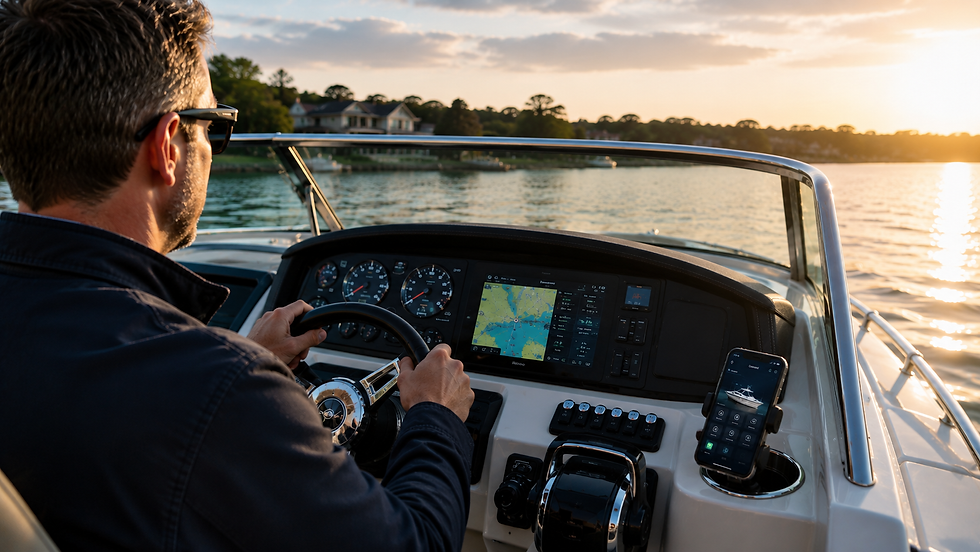
Now, Networked Displays are where your money goes furthest. Pulling out a tired single purpose chart plotter and dropping in a modern multifunction screen, one that shows radar, sonar, engine data, and camera feeds all in one place, will change how the entire helm feels—in a good way—not to mention the boating experience itself. If you are only going to do one thing, this may be the one. While most new systems aren't quite 'plug and play,' your dealer or marina should have the means to upgrade you to the latest displays, and within them lies a mountain of new features that even a five-year-old unit won't have.
Engine Monitoring is the quiet value pick. Real time diagnostics that flag a problem before it turns into a haul-out can usually be added with the right sensors and a compatible screen. Small line item, outsized payoff. This may depend on your engine's age, but most OEMs now offer mobile app connectivity with some retrofitting capability depending on model and type. The key distinction is whether the engine already generates digital data on a CAN/engine network. If it does, you can typically add a gateway/interface without having to replace the engine electronics (or the engine itself).
What You Probably Can't Get
Factory-level integration is the big hurdle. Boats designed around a digital backbone from factory have the wiring, sensor locations, and hull layout to match. Chasing that same seamlessness on an older hull means fighting old wiring, hunting for space that isn't there, and coaxing systems to talk that were never meant to.
True hands-off docking will mostly stay as a new build feature for now. Partial assist, yes. A boat that docks itself with you standing there watching? Not really. Not yet, anyway. The sensor arrays and drive-by-wire it leans on are hard and expensive to graft on after-the-fact.
It's also worth noting that a handful of the latest safety and stability features rely on sensors laid into the hull during the manufacturing process. Those can't be added later, full stop. No budget fixes it.
Roughly Where the Money Goes
The dollar values swing with boat size and where you're starting from, but here is a general rule: autopilot has the biggest probability to be the smallest slice of the budgetary pie, a networked display and its sensors will likely eat the biggest single chunk, docking assist lands somewhere in the middle depending on how much of your existing thrusters and cameras you can reuse, and engine monitoring usually tags along with the network display work.
That means if you spend $50,000, with a plan, you can genuinely modernize the helm on most mid-size to larger boats. What you can't do is make an old boat behave like a new one. It's worth being clear eyed about that from the start.
When The Refit Makes Sense
If you like the boat you've got, you plan to hang onto it, and you mostly want a helm that's easier and safer to run, a refit makes all the sense in the world. You can get most of the benefits of new electronics, but not all, and you can skip the price of a new boat.
If what you're chasing is full autonomous docking, or ground up integration full fulll modernization, a refit gets you in the neighborhood but not to the doorstep. That's the moment to be honest with yourself about whether you're upgrading a boat or shopping for a new one. Boaters like shopping for new boats, it's in our DNA. We also like a good project. Choose wisely.
Before You Ring Up a Dealer
There are a few things to nail down before you call your dealer and start the process. You should know: what of your current wiring and hardware can be reused, how long the install really takes, and what happens when something needs service later, because some of the newer gear ties you to dealer-specific diagnostic tools instead of whatever marine mechanic you trust.
You should walk in knowing what a refit can and can't do, so the whole conversation with your installer goes a lot smoother. #tips




Comments