
The Fastest Boats in the World Pt. IV - From Inboard to Outboard

We left Part 3 with the introduction of the hydroplane and stepped hull designs. These resulted in multiple Gold Cup and world speed record setters from the 1920s through to the 40s. But, we have some catching up to do and a change in direction to one of the most exciting aspects of water speed records – outboard engines.
So far in this series we have discussed only inboard-powered boats. But, from the first decade of the 20th century, outboard-powered boats have perhaps achieved more publicity since the engine brands setting the records have been available for purchase by the general boating public.
Let's explore the history.
In 1909, Ole Evinrude arguably invented and patented not only the first outboard motor, but the first commercially viable one that would start and run reliably. It produced 1.5 horsepower. Having sold his Evinrude company in 1913, he later created the Elto (Evinrude Light Twin Outboard) Motor Company and by 1920 they were producing a lightweight, twin cylinder, 3-hp outboard motor that quickly outsold Evinrude outboards.
The Johnson Motor Company started in 1922 in Waukegan, Illinois by four Johnson brothers. That year they introduced a reliable lightweight aluminum twin-cylinder outboard called the Waterbug that began to dominate racing. Johnson kept developing increasingly bigger horsepower motors to satisfy the growing need for speed. It soon began to outsell both Evinrude and Elto. The horsepower game had begun. In 1926, Ole Evinrude introduced the new Super Elto Twin but it didn’t take the market by storm because, that same year, Johnson had introduced its 6-hp Big Twin and set the first world outboard water speed record of 23 mph.

The Depression years saw the purchase by Elto of the failing Evinrude, and other companies, to form the Outboard Motors Corporation (OMC) with Ole Evinrude as President and Stephen Briggs (of Briggs and Stratton) as CEO. Ole's son Ralph Evinrude joined OMC after college and became President of OMC when Ole died in 1934. In 1935, Ralph oversaw the purchase of the financially strapped Johnson Motor Company and the name change to Outboard Marine Corporation (still OMC). Ralph promoted competition between the OMC outboard motor brands.
Born and raised in Wisconsin, Carl Kiekhaefer graduated as an electrical engineer and spent years as a draftsman for various companies. But he was a hands-on person and, in 1939, bought a struggling farm implement manufacturer with the idea of improving its products. Included with the purchase were some 300 Thor single-cylinder outboard motors that had been returned as defective by large mail order distributor Montgomery Ward. Instead of scrapping them, Carl decided to redesign and rebuild them, re-branded them as “Sea King,” then re-sold the much-improved 1.5 horsepower motors back to Montgomery Ward.

Shortly thereafter he received a large order for more. The national retail chain Western Auto Stores asked for a twin-cylinder design. Carl obliged, private-branded these newly designed 3-horsepower versions “Wizard,” and suddenly found himself in the outboard motor business. Having formed the Kiekhaefer Corporation and, to remove the stigma of the Thor name, for retail sales, Carl named his motors Mercury, after the Greek God of Speed. He introduced five Kiekhaefer Mercury outboard models at the 1940 New York Motor Boat Show to rav reviews - three single-cylinder and two twin-cylinder models simply labelled K1 through K5. Orders poured in.
Meanwhile, Evinrude and Johnson concentrated on setting UIM world speed records, the first coming in 1927 at 31 mph (49 km/h). In 1929, a Johnson broke 40 mph with a 42 mph (69 km/h) run. In 1930, an Elto 60 hp went 52 mph (84 km/h). These records were set in the USA but France, England, and Italy soon achieved world records of their own. A 1-litre Dupuy outboard in France broke the 60 mph barrier with a 65 mph (105 km/hr) run in 1934 on the Seine River, then again with the same size Dupuy motor on the Seine River at 74 mph (120 km/h) in 1936.

In 1953, an Italian Lesco 1-litre outboard upped the record to 83 mph (134 km/h) in Italy. The next year, another Lesco 1-litre broke the 100 mph barrier at 100.36 mph (162 km/hr). In 1960, a Mercury set a new record at 116 mph (186 km/h) in Seattle, Washington followed by an Evinrude V-4 in Havasu, Arizona at 131 mph (211 km/h) in 1966. It wasn’t until 1983 that the record broke the 140 mph barrier. It occurred in Windermere, England with a 3.5 litre Johnson running 144 mph (232 km/h).
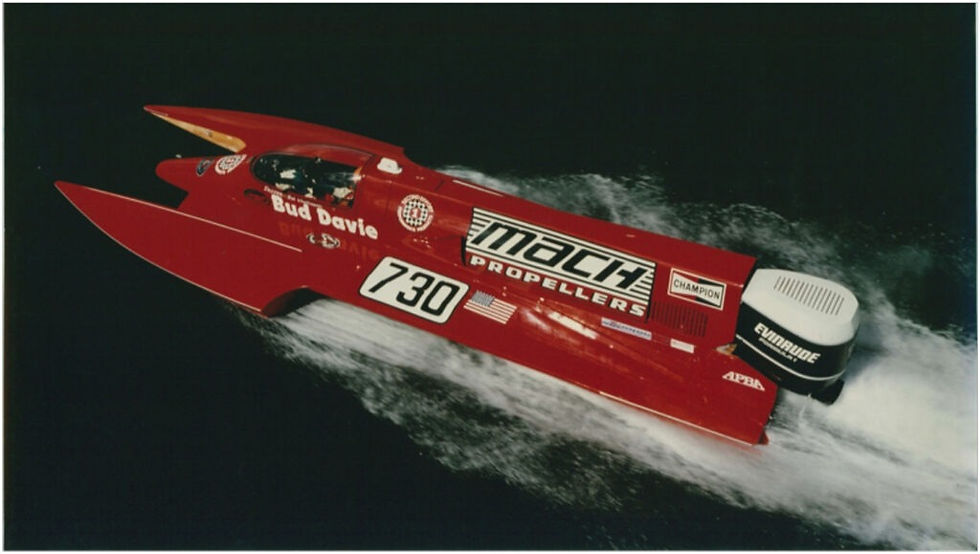
In 1984, in the USA, a 2.4 litre Mercury ran 157 mph (253 km/h). Finally, in 1986, Bob Hering set a new record of 169 mph (273 km/h) at the Parker Dam in Arizona with a 3.5 litre Evinrude. Today’s current APBA/UIM world single outboard water speed record was set by Bob Wartinger in 1989 at 177 mph (284 km/h) with another 3.5 litre V-8 Evinrude on the Mach Propellers 20-foot (6 m) Karelsen 3-point hydroplane.

The current diesel outboard record of 62 mph (100 km/h) was set by Cox Marine in 2022 in England running a 300 hp Cox Marine CXO300 diesel outboard on a 21-foot (6.4 m) Hallett Vector boat.

Princeton Electric Speedboating set the current single electric outboard speed record at 114 mph (183 km/h) in 2023. A team of graduate and undergraduate engineering students at Princeton University used a 14-foot (4.3 m) hydroplane powered by a 3-phase, 200-hp electric outboard motor of their own design. A few weeks earlier, a pair of Canada’s Vision Marine Technologies 180E electric outboards powered a 32-foot (9.8 m) S2 Powerboats catamaran to a record 116 mph (187 km/h) at the Lake of the Ozarks Shootout. Twin motors versus a single.

Here are another couple of interesting outboard speed records. In 2016, the first center console to break the 100 mph (161 km/h) barrier was a Nor-Tech 390 Sport CC with twin Mercury Racing 400R outboards. The official twin outboard world speed record is held by a Doug Wright Performance 320 catamaran powered by twin Mercury Racing 450R engines which ran 129.5 mph (208 km/h) in 2022 at the Desert Storm Shootout.
In terms of official racing standards, APBA Offshore Racing for large bodies of water has 15 classes including Class 1 (the premier, high speed, and internationally recognized class), Super Cat, Super Vee, Factory Stock, and Super Stock, plus Bracket Racing classes 100 through 700 with restrictions on maximum speed.

Now, you may have noted in the previous articles discrepancies between some of the records listed. That is because there is not just one world record for speed on the water but literally dozens of them held simultaneously.
To break this down, in 1902 Britain formed the Marine Motoring Association and in 1903 the Harmsworth Cup - where the first major boat racing trophy was awarded. In the U.S., the American Power Boat Association (APBA) was formed in 1903 to sanction power boat racing in America. It established the Challenge Cup in 1911, which soon became the Gold Cup series of races. An offshore race was held that same year from Long Beach to Catalina Island in California. In 1927, the Union Internationale Motonautique (UIM) was formed. At that point, UIM sanctioned boat racing within 11 European countries.
In 1946, the United States became a member of UIM through APBA. This is, generally speaking, when true World Champion designations could be awarded. The Canadian Boating Federation (CBF) was formed in 1950 to sanction boat racing in Canada and formed an association with the APBA in 1962 in order to gain international recognition and conformity of its racing classes. UIM headquarters moved to Monaco in 1988. As of 2026, UIM has 64 affiliated countries.
As we get further into this discussion of the world’s fastest boats, the research gets fuzzier and fuzzier. For example, today there are over 50 recognized world championship classes within UIM regulations and several potential designations within each class based on engine size, boat size, type of power, hull design, boat design, and even age category. So, there are dozens and dozens of world championship titles currently being recognized. Some of these titles are for overall speed, while others are for endurance speed. Others are for circuit winning speed.
With this proviso, we shall attempt to move ahead in determining The Fastest Boats in the World in overall speed. #culture




Comments