
The Fastest Boats in the World Pt. III - The End of the Monohull & The Rise of Hydroplanes

.jpg)
We left Part 2 with the back and forth water speed record achievements between Miss England III in the UK and Gar Wood in Miss America X in the United States. After the retirement of both boats in 1932, it became obvious that the era for monohull boats as the fastest in the world was coming to an end. But, there were still some hangers on.
At this same time, Canadian Harry Greening was making his mark in powerboating. As an executive at the family’s Greening Wire Company in Hamilton, Ontario, he spent his summers on Lake Muskoka and Lake Rosseau in Ontario’s coveted Muskoka region – a known hotbed for boaters. In 1904, at 24 years old, and five years before Ole Evinrude put his first outboard motor on the market, Greening built a small motor to power his canoe. In the years that followed, he steadily increased the size of the motor. (*Author's note* Harry Greening also happens to be a distant relative of mine on my mother's side whose maiden name was also Greening).
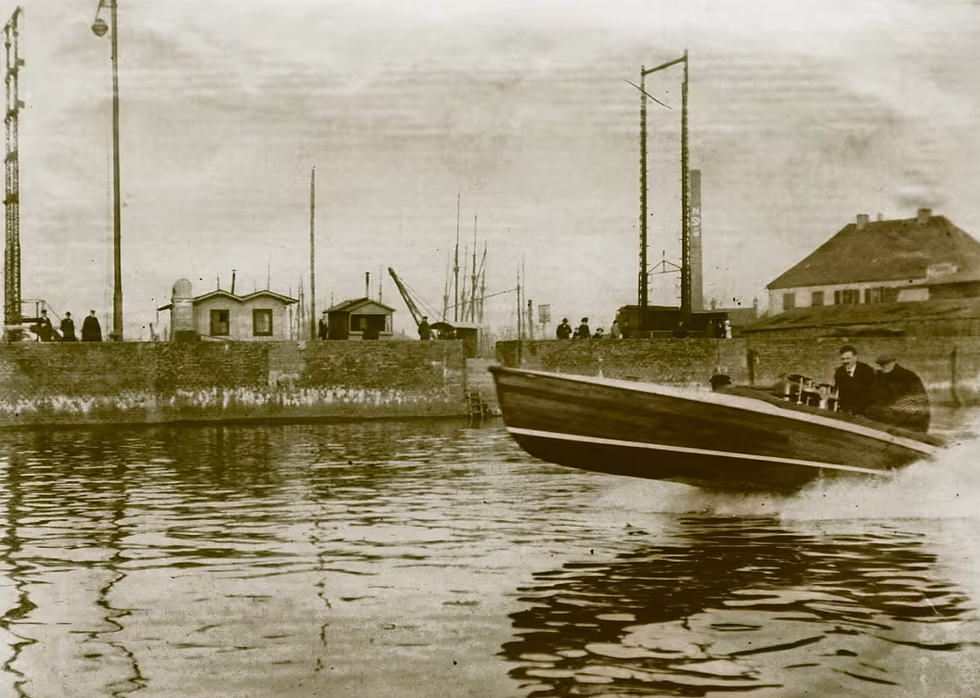
With his passion for speed firmly entrenched, Greening built a series of four progressively faster boats he named Gadfly. He then commissioned his first Rainbow race boat from Herbert Ditchburn in 1919 to be built in Ditchburn’s Gravenhurst, Ontario shop. This was the first of seven Rainbow racing boats in Greening’s decade-long quest for international racing and endurance records.
Rainbow I twice won the Fischer Trophy in the Gold Cup races in Detroit in 1920 and 1921. The John Hacker designed Rainbow III, with a lightweight 400-hp Packard-Liberty aircraft engine, claimed to be the first planing hull with an external propeller and rudder. It was well ahead in the 1923 Gold Cup cumulative points races before it was forced to retire with mechanical issues.

In 1924, the 27-foot (8 m) Rainbow IV won the Gold Cup by a huge margin but featured a lapstrake hull bottom akin to dozens of small steps. It was originally accepted by race officials, but they later disqualified it following its race win. In 1925, Rainbow IV went on to set the 24-hour world distance record of 1218 miles, thus breaking the former world record set by Rainbow III. Greening, representing Canada, won the Duke of York Trophy race in England with Rainbow V and contested the Gold Cup again in 1928 with Rainbow VII winning the Lipton Trophy and beating Gar Wood. He retired from boat racing in 1929. He died in 1960 at age 80.
Following in Greening’s footsteps, and starting in the 1930s when Miss England III and Miss America X were still battling it out for speed supremacy, Canadian Harold Wilson also entered the scene. His passion for boats came honestly. His father Ernie was president of Greavette Boats in Gravenhurst, Ontario – one of Canada’s premier boat manufacturers in Canada’s upscale Muskoka Lakes cottage district. Harold’s wife Lorna was also one of the first female mechanics. Together, they embraced the world of high-performance boats.

Before World War II, the Wilsons competed in American dominated Gold Cup races with the Hacker-designed Miss Canada II. Later they switched to the Van Patten-designed Miss Canada III, each powered by single Miller V-12 supercharged engines. They also represented Canada in European races. In 1939, Miss Canada III won the President’s Cup, the first Canadian boat to win a major Gold Cup Class trophy and the best Canadian Gold Cup contender since Harry Greening in Rainbow IV in 1924.
Despite the advances in 3-point hydroplane design, in 1949, the Wilsons launched their new 33-foot (10 m) mahogany hydroplane Miss Canada IV, featuring three stepped lifting surfaces and powered by a supercharged Rolls-Royce Griffon V-12 aircraft engine producing 3,000 horsepower. This huge piston engine displaced over 2000 cubic inches – equal to 37 litres.
Later that year, Wilson claimed a North American speed record of 139 mph (224 km/h) on the Trent River near Picton, Ontario, east of Toronto. This was Canada’s first-ever water speed record, surpassing Gar Wood. But alas, Miss Canada IV never won the coveted Gold Cup or Harmsworth Cup for which it was designed. In 1951, the Wilsons sold it to Gordon Thompson of Sarnia, Ontario to become his original Miss Supertest.

And now we go back to England. In 1906 at age 21, Sir Malcolm Campbell won the first of his three consecutive London to Land’s End motorcycle races. Then he began racing cars in 1910. In 1924, he broke the land speed record for the first time at 146 mph (235 km/h) in a specially built 350-hp Sunbeam race car. He broke nine land speed records between 1924 and 1935, five of which were at Daytona Beach, Florida. The 1927 record was 175 mph (282 km/h) and his final land speed record set at the Bonneville Salt Flats in Utah in 1935 was 301 mph (485 km/h), the first person to drive an automobile over 300 mph. Next he turned his attention to boats.
Campbell reached out to Fred Cooper of Saunders Roe, the naval architect who had designed the Miss England series, to design and build the small and lightweight Blue Bird series of hydroplanes. After a few years and several attempts with early models, Blue Bird K3, a 23-foot (7 m) monohull hydroplane powered by a single Rolls Royce supercharged V-12 aero engine taken from Miss England III and producing 2,000 horsepower, set two new records in 1937. Campbell led the boat to top speeds of 126 mph (203 km/h), then 130 mph (209 km/h), and finally in 1938 to 131 mph (211 km/h), all surpassing Gar Wood’s record.
Not satisfied with this incremental increase in speed, Campbell learned of the revolutionary three point hydroplane design being advanced in America. In response, he had Blue Bird K4 built in 1939, a new 23-foot (7m) three-point hydroplane design that re-used the single Rolls Royce engine out of K3. With Blue Bird K4, Campbell set a new world speed record of 142 mph (229 km/h) in late summer 1939. The record held for 11 years. Sir Malcolm Campbell died of heart failure in 1948 just as jet engine technology was about to enter the world of water speed records.

Back in America, in 1946, Guy Lombardo, the bandleader of the famous Royal Canadians, won the Gold Cup in his three-point hydroplane Tempo VI powered by a 1,300-hp Allison V-12 aircraft engine. Born in London, Ontario, Lombardo and his band gained fame with the first nationwide New Year’s Eve live radio broadcast in 1929 and lasted through 1976 with his rendition of Auld Lang Syne closing every show.
In 1946, Lombardo set a world water speed record for Gold Cup Class boats at 113 mph (182 km/h). He won a total of 15 Gold Cup Unlimited or Class victories between 1946 and 1953. In 1955, the brand new 29-foot (9 m) Staudacher-designed Tempo VII was almost unbeatable in Unlimited Class Gold Cup racing. In 1959, in conjunction with the Aluminum Company of America (Alcoa), he made an attempt at the world speed record with his pickle fork-style, radio-controlled, jet-powered aluminum constructed Tempo Alcoa.
While not completing the required two-way run, the boat surpassed 250 mph (402 km/hr) on Saginaw Bay, Michigan before it broke apart from a structural defect and was destroyed. In 1963, on a movie shoot, Lombardo took a spectator named Bernie Little for a ride in his four-seater pleasure three-point hydroplane. Little loved it, bought it on the spot, and it became the first Miss Budweiser.

The last of world speed records using the piston engine was set by the Seattle, Washington-built three-point hydroplane, Slo-Mo-Shun. After some initial development and testing work on earlier models, Slo-Mo-Shun IV, designed and piloted by Ted Jones and built of mahogany plywood, set multiple water speed records. At 28 feet (8.5 m) long and over 11 feet (3.4 m) wide, it was powered by an 1,800-hp Allison piston aircraft engine swinging a two-blade propeller at up to 10,800 RPM.
In 1950, it ran 160 mph (259 km/h) on Lake Washington in Seattle. It was designed so that the top of the propeller was out of the water at speed, thus reducing drag. This was perhaps one of the first “surface running props” that would revolutionize propeller design and increase water speeds in the years ahead. Jones drove it to the APBA Gold Cup win in Detroit in 1950, plus the Harmsworth Cup, making it the first boat since Gar Wood in 1920 to win both those races. In 1952, Slo-Mo-Shun IV set a new world water speed record of 178-mph (287 km/h).



Comments