
The Fastest Boats in the World Pt. II - The Race to 100 Mph

Updated: Feb 25

We left Part 1 with the establishment of the world’s first official speed record for internal combustion engine (ICE) powered boats. It was set by the British-built 40-foot (12 m) Napier I race boat driven by Dorothy Levitt as the winner of the inaugural Harmsworth Cup in 1903 at a blistering top speed of 21 mph (34 km/h).
Before that, steam-powered boats had already reached speeds of 26 mph (42 km/h) in 1885 and as high as 45 mph (72 km/h) in 1903.

In 1904, the American Power Boat Association (APBA) created The Challenge Cup which has been known since as the Gold Cup. The first race, on the Hudson River in New York, was won by the nearly 60-foot-long displacement hull Standard having an average speed of less than 25 mph from its 110-hp Standard engine. In that same year, at 27 years old, accredited marine designer John L. Hacker’s revolutionary shallow V-bottomed Au Revoir was recorded as being the world’s fastest boat. In 1905, Chris Smith had built his first Chris-Craft race boat achieving an ultra-impressive speed of 25 mph (40 km/h).
Although the hydroplane with a single step built into tandem planing hulls was first patented by Reverend Charles Ramus in England way back in 1872, the multiple-stepped hull was first patented in the USA in 1908. It wasn’t until the 1930s that two separate side-mounted stepped sponsons became the three-point hydroplane. The planing flat bottom and shallow V-bottom hulls and the stepped planing hull designs forever changed the speeds of power boats.
In 1911 in England, the 40-foot (12 m) single-step hydroplane Dixie IV powered by two 250 hp V-8 engines recorded speeds of up to 46 mph (74 km/h). Also in 1911, the APBA Gold Cup was won by a planing hull instead of a displacement hull for the first time. The Hacker-designed stepped-hull hydroplane Kitty Hawk won the Gold Cup that year and set an unthinkable speed of over 50 mph (80 km/h). Also that year in England, the Maple Leaf III, with a pair of 12-cylinder engines of 350 hp each, set a new speed record of 57 mph (92 km/h). In 1912, Chris Smith set the US record of 54 mph (87 km/h) in Baby Reliance II.

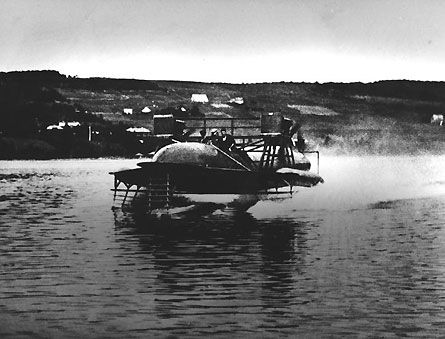
The war years understandably curtailed most pleasure boating activities, especially in Europe, but in 1916, Chris Smith set a new world speed record of 64 mph (103 km/h) in his custom designed and built Chris-Craft. Then in 1919, speed on the water changed dramatically. Sir Alexander Graham Bell – yes, that one – the inventor of the telephone and dozens of other scientific patents, after reading an article in Scientific American, started his own research into hydrofoils in the early 1900s as a way to assist airplanes to take off from water.
Following his involvement in the design, construction, and successful flights of Canada’s first heavier than air Silver Dart, very shortly after the Wright Brothers, Bell’s knowledge of wing design and the principles of lift in airfoil design would prove to be invaluable to his interest in hydrofoils. During World War I, Bell, utilizing available research while refining his own designs, built several experimental hydrofoil boats culminating in the HD-4. The boat was initially powered by Renault engines and attained an astounding top speed of 54 mph (87 kph). Later in 1919, with a pair of heftier 350 hp engines, the HD-4 set an on-water speed record on Bras d’Or Lake, Nova Scotia of 71 mph (114 kph).
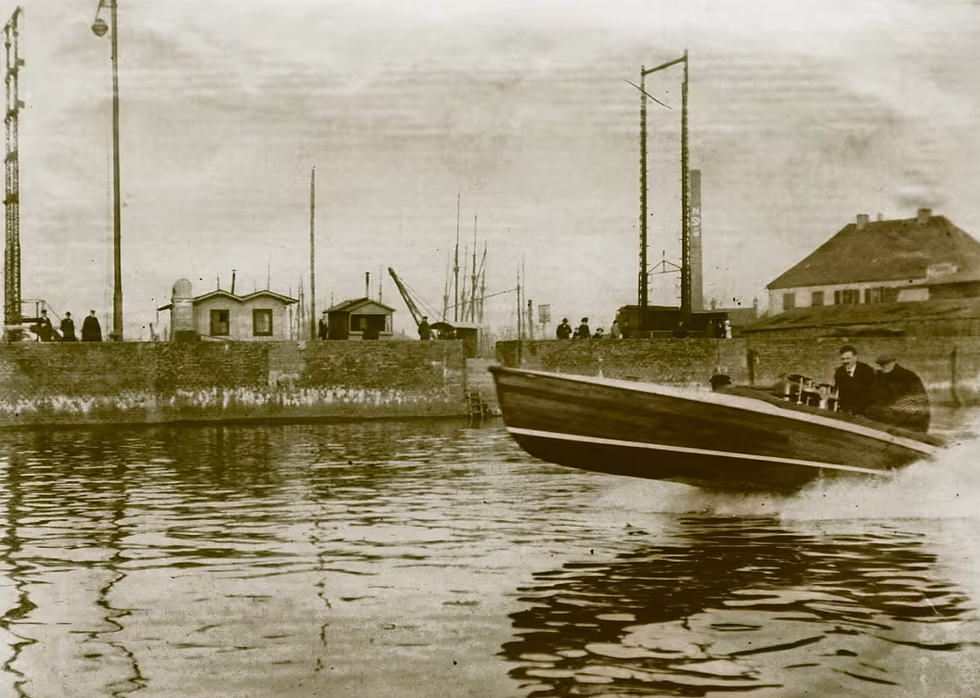
Already a successful entrepreneur and businessman, Garfield (Gar) Wood, who’s father was a ferryboat operator, purchased his first race boat in 1916 from Chris Smith called Miss Detroit. Wood then bought Chris Smith’s boat building company. Together they designed and built the first of ten Miss America speed boats. Powered by a pair of Liberty V-12 engines by Packard, Wood drove the first Miss America to a new water speed record of 75 mph (121 km/h) on the Detroit River in 1920.
In 1921, Miss America II won the Harmsworth Cup with Wood at the helm and set a new world speed record of 81 mph (130 km/h). In 1928, Wood drove Miss America VII to 93 mph (150 km/h) on the Detroit River. He set five more records including the 30-foot (9 m) Miss America IX powered by twin 1200 hp Packard V-12 engines in 1931 -- the first boat to exceed the 100 mph (161 km/h) barrier.
His last record was set in 1932 with the 38-foot (11.5 m) Miss America X running 125 mph (201 km/h) on the St. Clair River. Built by Chris Smith of mahogany, it was powered by four Packard supercharged V-12 engines producing a total of over 7,000 hp.
Meanwhile in England, word of the American speed records prompted Castrol Oil to sponsor noted British Naval Architect Fred Cooper to design a lightweight single-step hydroplane to be built by the British Power Boat Company in 1929. It was powered by a single Napier Lion aircraft engine producing 950 horsepower. Driven by legendary land speed record holder, Henry Segrave, Miss England was not fast enough to challenge the speeds of Gar Wood but it did win the Motor Boat Championship of the World in 1929 and set the record as the fastest single engine boat in the world at 92 mph (148 km/h). Henry Segrave became the only person to ever simultaneously hold both land speed and water speed records.

On behalf of Castrol Lubricants founder Lord Wakefield, Fred Cooper then designed the 36-foot (11 m) monohull hydroplane Miss England II powered by a pair of 1,800 horsepower Rolls Royce V-12 aircraft engines connected to a single propeller. This new race boat featured a removable step that could be positioned and bolted where needed on the hull to maximize speed depending on load, balance, and water conditions. The cockpit had seating for three; engineer, mechanic, with the driver centred between them.
On Friday the 13th in June, 1930, with Henry Segrave driving, Miss England II set a new world record of 99 mph (160 km/h) average over two runs. On a third run, the boat hit a tree branch in the water and flipped over killing, Segrave and his engineer. Miss England II was salvaged and in 1931 was driven by Kaye Don to an unofficial record of 107 mph (172 km/h). Gar Wood then created his official record of over 100 mph (160 km/h) which was then upped by Kaye Don in Miss England II to 110 mph (177 km/h), which was topped early in 1932 by 1 mph and later in 1932 to 125 mph (201 km/h) by Gar Wood.
The 35-foot (11 m) Miss England III was powered by twin 2,000 horsepower supercharged V-12 Rolls Royce aero engines with each one driving a separate propeller with a rudder behind it along with a forward steering rudder as well. In July of 1932, Kaye Don drove to a new water speed record of 120 mph (193 km/h) on Loch Lomond in Scotland. This was followed a month later by Gar Wood’s 125 mph (201 km/h) record run in the four-engine Miss America X.
Miss England III was retired after losing to Gar Wood and Miss America X and failing to reclaim the Harmsworth Cup for Britain in 1932. Her Rolls Royce engines were loaned to Britain’s Sir Malcolm Campbell in his quest for a land speed record of over 300 mph (483 km/h). The Miss England series of race boats were said to have been destroyed in a WWII air raid blitz in 1940.
This was the end of racing for Gar Wood, who turned his attention to his many businesses. It marked the end of an era in water speed records. As an aside, Gar Wood also won five straight Gold Cup races between 1917 and 1921 and the Harmsworth Cup and its trophy nine times between 1920 and 1933. It's also worth noting, Chris Smith and Gar Wood officially split up in 1922, each establishing his own boat building company with Chris Smith changing his company name and boat brand to Chris-Craft in 1924. He continued to build race boats for Gar Wood.
Miss England III and Miss America X were the last of the conventional single-keel boats with planing hulls (monohull hydroplanes) to chase world water speed records. As we will see in Part III, Sir Malcolm Campbell, holder of the land speed record, would drive a much smaller and lighter single-engine Blue Bird K3 to a new world water speed record. #culture


You forgot to mention the Miss Canada 2,3, and IV raced in both presidents cup, Harmsworth and Gold cups, with a rolls Royce Merlin and later Griffin 3,000 hP engine. Harold and his wife racing mechanic Lorna Wilson. Unofficially set world record at about 210 mph early 50’s. Boat still survives and runs.