
The Floating Gathering: Four Trends That Changed How We Socialize in Boating

By: Manhoor Irfan

There's a moment that every boater knows.
The anchor drops, the engine goes quiet, and within twenty minutes another boat has appeared on the horizon heading your direction. Then another. By early afternoon, there are six boats tied together, a cooler moving from deck to deck, and someone's Bluetooth speaker providing the soundtrack to an afternoon that nobody planned but everyone needed.
Nobody sent invitations. Nobody booked a venue. The water just has a way of pulling people together.
Floating gatherings, raft-ups, sandbar parties, cove meetups, call them what you want, have become one of the defining rituals of modern recreational boating. And it turns out the boat industry noticed. Because while boaters were busy inventing new reasons to tie their boats together and stay out past sunset, boat designers were quietly rebuilding the modern vessel around that exact idea.
It Didn't Start This Way

For most of boating's history, the design brief was pretty simple: go fast, handle well, and if there's space left over, put a seat in it. The bow of a traditional runabout was a closed, pointed affair, functional from a hydrodynamics standpoint, completely useless from a social one. If the front of the boat had anything going on below deck, it was a tiny berth that fit one adult sideways, or a storage compartment full of life jackets and old sunscreen.
The boat was a vehicle. You drove it somewhere. That was the point. The first bowrider boat is largely attributed to Vic Porter from Formula Boats in the mid 60s, featuring an open bow area with seating at the front, allowing for more passenger space than traditional runabouts or fishing boats. It sounds simple in hindsight, but at the time it was a genuine philosophical shift, the idea that the bow of a boat could be a room rather than a structural afterthought. Instead of pointing the front of the boat at the horizon and filling it with equipment, you could face your passengers toward each other, give them somewhere comfortable to sit, and let the whole experience open up.
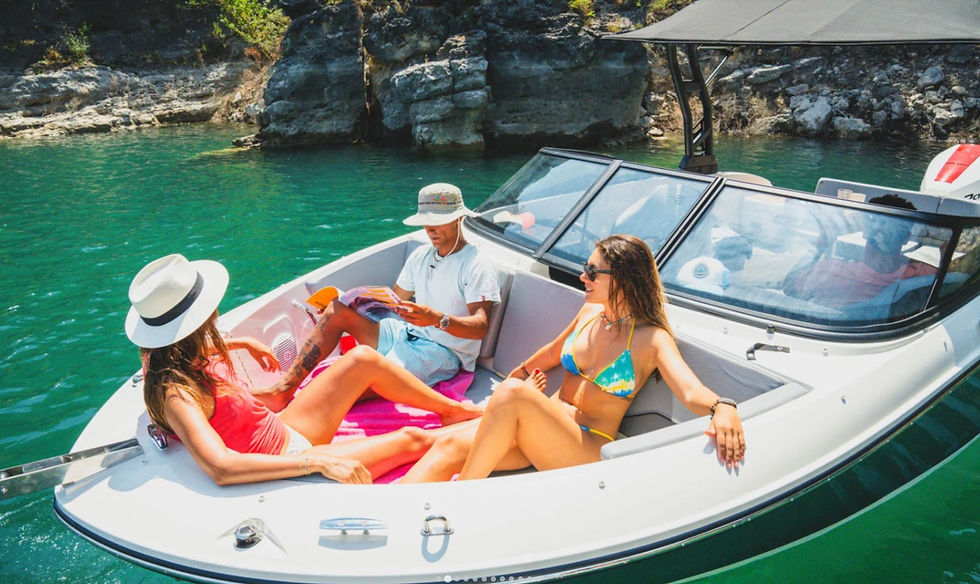
The open bow design quickly gained attention for its ability to foster socializing while providing unobstructed views of the surrounding water. By the 1970s and 80s, bowriders had grown in size and sophistication, and the conversation in boat design quietly shifted. Performance still mattered. But so did the people on board.
Then Came the Pontoon

If the bowrider cracked the door open on social boating, then the pontoon boat kicked it off the hinges.
For years, pontoons were affectionately, and sometimes condescendingly, dismissed as "party barges." Slow, flat, unglamorous. Not a real boat, some would argue, but a floating patio. That was not the insult it was intended to be. It turns out people really like floating patios.
The pontoon boat category has consistently gained in popularity over the years, and today the segment accounts for more than 38% of the entire new powerboat market in the U.S. In 2022, the pontoon boat was the most popular type of boat among recreational boaters.

The reason is straightforward: pontoons are purpose-built for the kind of day most boaters want to have on the water. Wide, stable, flat decks. Room to move around. Space to bring the whole group. Easy boarding from the water. There is no pretense of performance on a pontoon, it is openly, unapologetically a social vessel, and the market has rewarded that honesty enthusiastically.
Manufacturers responded in kind. Today's pontoons bear almost no resemblance to the simple aluminum platforms of thirty years ago. The idea of how to utilize a pontoon boat has expanded from simply a vessel for lounging or partying to a boat that's also powerful enough for everything from water sports to legit performance. Luxury upholstery, built-in coolers, wet bars, surround sound, LED lighting packages, the modern pontoon is less a boat and more a floating living room that happens to have an engine attached. In some cases, several engines.
The Fold-Down Terrace: More Floor, More Party

While pontoons may be dominating the social boating conversation at the entry level, a quiet design revolution is spreading upmarket, too. And it came in the form of a hinge.
The fold-down stern terrace, where the sidewalls at the stern collapse outward to dramatically expand the usable deck space, is one of those ideas that seems obvious the moment you see it. Why didn't anyone do this sooner? We covered it in our Four Tech Trends Primed to Change Boating in 2024, and several major manufacturers have already committed to the feature. It's spreading fast. Cruisers Yachts built it into their entire new flybridge series. The Regal 50 SAV deploys fold-downs on both sides to create what amounts to a dance floor at the stern. The Wellcraft 435 uses a similar layout that redefines what a performance cruiser can offer in terms of social space.

Wellcraft 44 Explorer 
Regal 50 SAV
The effect is transformative. A boat that might comfortably host six people in the traditional stern configuration can suddenly host twelve. The boundary between the boat and the water, always the best part of the experience, essentially disappears. You are no longer in a boat with a view of the water. You are basically on top of it, surrounded by it, with room enough to share it with everyone you brought.
The Aft Galley: Cooking Where the Action Is

There's another quieter shift happening that deserves attention, and it has to do with where the kitchen goes.
On traditional cabin cruisers, the galley, the kitchen, lives below deck. Which makes a certain kind of practical sense. It's protected from the elements, it keeps the cooking mess contained, and it maintains the clean lines of the deck above. The only problem is that the person cooking is trapped below while everyone else is topside enjoying the actual day.
The aft galley flips that arrangement. By moving the cooking area to the stern, the largest, most social part of the open deck, boatbuilders have essentially acknowledged something boaters have known for a long time: the best conversations happen around food, and nobody wants to miss them. The aft galley puts the cook in the middle of the party rather than exiling them to the cabin. Grill out, hand drinks over the counter, stay in the conversation. It's a small design shift with an outsized effect on the social experience of a day on the water.
The Water Has Always Been Social. The Boats Are Just Catching Up.
What's interesting about all of this is that boaters didn't need to be told to gather. The raft-up, the sandbar meetup, the lazy afternoon with four boats tied together and nobody going anywhere, these rituals existed long before the boats were designed to support them. Boaters have always found a way.
But now the industry is designing toward that instinct rather than incidentally accommodating it. The bowrider put social seating at the bow. The pontoon made the whole boat a gathering space. The fold-down terrace removed the last physical barrier between the deck and the water. The aft galley kept the cook in the conversation. Taken together, these changes tell a consistent story: the modern recreational boat is being designed not just to get somewhere, but to be somewhere, with people, on the water, for as long as the captain decides the day lasts. Which, as any veteran passenger knows, is always longer than you expected. And somehow, always worth it. #culture


Comments