
Shore Power Explained: Preventing Faults, Corrosion, and Electrical Hazards


The theory and perception of shore power is an amazing one. You plug an extension cord from the dock into your boat, and you have all the comforts of home. So simple.
The reality is boat power and house power are vastly different in a number of important ways. Knowing these differences, and knowing how to best to manage shore power onboard, can make your time at dock more enjoyable and will keep you safer.
Before we kick things off, I should point out: as I write this, I’m imagining a decades-old power or sail boat that has changed hands over more than one owner. As with many electrical issues aboard, the culprit tends to be older boats that have been slowly upgraded overtime. In years and decades past, in order to charge a boat’s batteries and run a few simple AC appliances, an extension cord was run from a nearby shed, along the dock to a boat tied alongside. Over time, this convenience came into high demand, and some order was needed in the chaos of extension cords near water. Marinas began using shore power pedestals, with each dock assigned a plug, and boaters began using standardized 30A and 50A ‘shore power cords’ as receptacles aboard became the norm. More recent advances have become the ‘twist-and-lock’ and SmartPlug variants, along with a variety of pigtail adaptors and sealed connections.

So far, this may sound pretty similar to your house. You have main power coming into your basement to your fuse box or breaker panel. The breaker panel then branches off to feed outlets and appliances. It's secure, it's safe, and you don’t have to think about it.
The first factor that separates house power from boat power is the possibility of stray current. In an ideal world, current will flow from the marina’s power lines along the dock to each pedestal. When a boat is plugged in, current will flow from the shore-power pedestal along the shore-power cord, into the boat, and into each appliance and outlet that is powered on. The simplified theory in AC wiring is that the black (hot) wire will carry current to the appliance. The white (neutral or grounded) wire carries current back to its source. The green (grounding) wire is not normally carrying current, and is used as a way for stray current to make its way to a safe source (ground).
However, when looking at a boat that is plugged into shore-power, the ‘safe ground’ that we’re talking about isn’t aboard the boat. Rather, it’s back on shore.
There are a few ways this can happen. Water splashing onto a receptacle mounted in a cockpit. Condensation building up in a receptacle in a head. High humidity allowing the hot wire to make unexpected contact with the appliance casing in a toaster, coffee maker, or hair dryer.

When this happens, the green (grounding) wire becomes energized. It's not supposed to be. That green wire should also be part of the boat’s bonding system. It connects the AC to the DC system, and also connects all the metal machinery and through-hulls. Suddenly, the moisture inside your toaster has energized your engine, through-hulls, electronics, and even your railings. That current will be looking for a place to ‘ground.' But, as mentioned earlier, there is no ground aboard your boat. The ground is back on shore. So, the current that is now running through the underwater machinery of your boat will try to find the easiest path to ground that it can find. It may run through your through-hulls and through the water to the dock frame. It may run through the water to your neighbours boat (through their shaft and propeller and through their electrical system). If a swimmer were in the water between the boat and shore when this takes place, the current may run through their body causing paralysis, heart failure, and drowning. This is called ‘Electric Shock Drowning.’
A further result of stray current running between boats and shore is the electrolytic corrosion that can take place. Dissimilar metals, with an electric current between them causing an extremely fast reaction, damaging underwater machinery, through-hulls, props and drives.
Protecting your boat, your marina neighbors, your family, and your guests aboard from AC electrical issues is best achieved by looking at both sides of the system: from shore power into the boat (by adding an ELCI breaker), and from the main AC breaker panel to the outlets and appliances (by installing GFCI outlets).
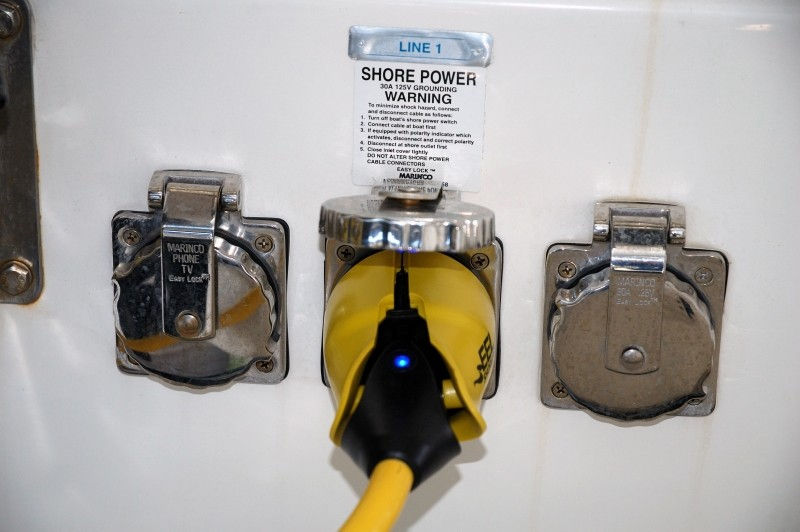
Now, the next item that separates household electricity from boat electricity. We connect, disconnect, and reconnect shore power on a boat OFTEN. This is never done in a house. Once the connection is made, it’s considered permanent. Two main issues can be common because of this:
First, is wear-and-tear on the connection points. The shore power plug loosening and not creating tight contact with a solid seal. The possibility of current arcing between the shore power cord and inlet is a real one, and quite dangerous.

Second is the possibility of ‘reverse polarity.’ This is where the hot and neutral wires are reversed (either through wiring or an improper connection. This is particularly dangerous, as all the boat’s circuit breakers are designed to work with the ‘hot’ wire, not the neutral one. This means that if the neutral wire is energized, the appliance may still work, but there will be no protection against overheating or fire.
Finally, the harsh marine environment separates boats from houses. Moisture, vibration, movement, tides, corrosion - these all have an impact on a boat’s connection to shore. Often, marina shore power pedestals, shore power cords, and shore power inlets on the boat side suffer from high wear-and-tear, loose connections, arcing, breakdown due to vibration, and water intrusion. Shore power cords and connections should be inspected regularly and replaced at the first sign of trouble.
How to keep yourself and your boat safe:
Perform a Visual Check: Turn off all AC power at the dockside pedestal and the boat's main breaker first. Inspect both ends of your shore power cable and the inlet on your boat. Look for melting, scorching, green corrosion, or loose/bent prongs.
Isolate the Loads: If the dock pedestal keeps tripping, unplug your shore power cord and test with a multimeter. Plug the cord into the dock without connecting to the boat, then turn on the dock breaker. If it trips, the cord is bad and should be replaced.
Trace Internal Systems: If the dock holds but the boat's main breaker trips, turn off all individual branch breakers on your boat's AC panel. Re-engage them one by one to find the specific appliance or circuit causing the overload or ground fault.
In the Event of Reverse Polarity: Unplug immediately. Check the plug connections to make sure that they were plugged in properly. Test again using a different cord that is known to be good. If the polarity changes, replace your shore-power cord. Check the dock pedestal and alert the marina. Check your boat’s breaker panel, keeping an eye out for any loose connections.
Protect Your Boat: Install an ELCI breaker between the shore power inlet and the AC Breaker panel, and install GFCI outlets at each receptacle. Be safe. Know your connections. #tips


Comments