
How AI Is Already Changing the Boating Experience

Updated: Apr 17

AI has already begun revolutionizing the way captains move and react on board.
In the days of yore, captains relied on experience, intuition, conventional navigation, and mechanical telemetry. As a new AI era begins, the adoption of AI boating technology gives captains entirely new ways to control and operate their various onboard systems. This includes everything from systems monitoring, navigation tools, cameras and security monitoring, and beyond. New AI tech can identify threats in the water, choose the best navigable route, anticipate changes in the environment both above and below the waterline, and improve overall safety. At its core, AI-assisted boating can, and will, take some of the burden off the captain when it comes to vessel operation. At the most basic level, AI-assisted boating combines information from cameras, radar, GPS, and sensors to form a more comprehensive dataset of both the vessel itself and the surrounding area. In broad strokes, the goal is to make boating safer, less stressful, more efficient, and more precise. But, in doing so, the technology also requires the operator to relinquish control in ways they have never had to before.
AI-Powered Hazard Detection

Hazard detection is one of the most promising solutions in AI-assisted boating. Traditional navigation relies upon a captain's sightline and well-established mechanical and digital instrumentation that has been in production for decades. AI solutions can enhance the traditional visual capability through the identification of obstacles, buoys, swimmers, submerged objects, or other hazards via environmental monitoring. They accomplish this by means of 360-degree cameras and enhanced vision technology ( like FLIR and thermal imaging, for example). When deployed along with a captain's traditional methods, AI helps a captain to identify potential hazards before they can otherwise be seen. Even if a captain cannot see the hazard physically, or their GPS or sonar doesn't register the object, AI monitoring systems can.

The SEA.AI Watchkeeper is an AI-based camera system that provides continuous surveillance to complement the captain. It can increase safety and awareness both day and night by providing the captain with information beyond the typical parameters. Watchkeeper can detect objects like floating debris, buoys, swimmers, and other boats that aren't necessarily visible due to waves, weather, or lighting. During daytime and at twilight, RGB cameras provide safe navigation by assessing the area, and at night thermal cameras provide enhanced night vision when line of sight isn't available. The key advantage is its ability to integrate easily with existing navigation displays that are available from most major manufacturers.
Smart Collision Avoidance and Protective Bubbles
AI has also proven to be capable of preventing a collision, even if the captain and traditional onboard systems don't register (or see) an imminent threat. In essence, collision-avoidance technology provides a "protection bubble" around a vessel. The system continually monitors and measures the distance between a vessel and any surrounding objects, then raises an alarm if anything crosses a specific threshold. Advanced systems can even integrate with a boat’s steering and propulsion to take corrective action automatically before, or without, input from the captain. Collision avoidance systems are similar to autopilot, but add extra AI assistance that mitigates the probability of human error.
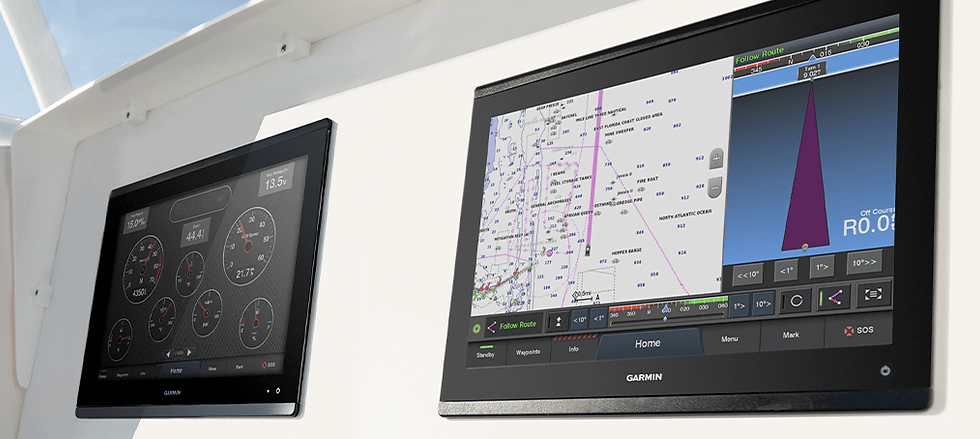
As an example, the Garmin Autopilot with SmartTrack utilizes a 9-axis solid-state Attitude Heading Reference System (AHRS) that helps a vessel stay on a stable course and actively counteracts pitching and rolling while navigating through choppy seas. The system constantly, and automatically, adjusts the steering angle to prevent course deviations and reduce heading errors, while also minimizing the amount of excess steering and power used. In the end, passengers get a smoother ride that limits exposure to unnecessary movement from the boat. When used in combination with Garmin Fantom Radar, the system gains additional capabilities like identifying and monitoring nearby objects. As it detects them, the data is fed to the system for the captain to respond accordingly, allowing them to deviate course by manual operation or have the system reconfigure the best route to avoid a collision. Fantom Radar uses automated target detection that constantly feeds information in real-time, supplying updated information potentially faster than a captain can see or respond to.
Autonomous Docking

Docking is commonly described as one of the most stressful tasks in boating, particularly if weather or water conditions are affecting the boat's movement. AI-based autonomous docking systems address the issue of outside influence, using automation to provide precise guidance for the captain. They factor in elements like wind speed, direction of current, the angle of approach, the location of nearby objects (docks, other boats, piers, etc) and the boat's physical dynamics.

New products like the Avikus AI NEUBOAT docking system use advanced perception technology during low-speed maneuvering to help control a vessel's movement. The system incorporates obstacle recognition, distance calculations, and the boat's movement to analyze and apply input during docking. The system takes into consideration environmental factors like wind or currents and offsets its influence, which in turn makes it easier and safer for captains to control the boat with accuracy. The return is greater control where outside factors are minimized or removed altogether.
The Neuboat Dock II system works by providing a complete panoramic 360-degree visual field with pan/tilt/zoom function, dynamic object detection, and a "virtual bumper" to give the captain a perceptible failsafe boundary around the boat that they can see on screen. Other major manufacturers like Brunswick Corporation have similar systems like Simrad AutoCaptain - the world's first fully autonomous docking system that can dock a boat completely without operator input.
AI Navigation and Route Optimization
A new dimension in marine navigation is also being influenced by AI. Navigation routes can now be optimized to account for everchanging factors like boat traffic congestion, weather changes, and water depth affected by tides. Not only does it make for a safer trip, it also generates the most economical one, too.
Furuno is integrating AI into navigation with innovations like the VR Navigation System (3D Bird View), which optimizes route planning and awareness by creating a live three-dimensional perspective of the vessel and its environment. It integrates crucial information like chart data, radar information, AIS targets, and risk areas for collision into one interface, which provides the captain with a realtime screenshot of all the factors influencing his route and safety. The system can also be adjusted to change the altitude, angle, and zoom level, giving operators the ability to evaluate the traffic, risks, and the best route using multiple vantage points, which makes it even more useful when navigating congested waters. The concept has largely been applied thus far to commercial ships due to the safety risks posed by large vessels in busy waterways, but smaller systems are already available for superyachts, yachts, and even dayboats.
Predictive Weather and Wave Analysis

Weather is one of the most unpredictable aspects of boating, but AI can now give captains better realtime data to anticipate changes in the environment. Through a unique analysis that blends both historical and realtime data, AI software can forecast weather trends, weather patterns, and wave formation sizes with remarkable precision. In turn, the captain receives greater lead time to alter course or prepare for changing conditions.
PredictWind uses AI technology to craft weather and water predictions using their Polars interface. The system gathers real-time information about the vessel it's attached to through sensors and equipment from the PredictWind DataHub. In return, PredictWind trains the software to understand how the boat behaves under various weather conditions. Once the system is plugged directly into the boat's instruments, PredictWind begins tracking the boat's realtime data to create an optimized 'boat polar' that matches the vessel's performance characteristics and style of operation. For example, by supplying data to the machine learning polars, things like wind speed, wave height and periods, and behavioral changes like slower travel at night are all factored in. The system comes to learn the waterway and its vessel. With a baseline dataset, PredictWind uses its weather routing to suggest an optimal route based on the predictive data and the boat's known performance capabilities and tendencies (i.e., if it must move slower at night, it may choose another course that factors in the probable speed). The company also has related products like mobile and desktop apps that give access to a multitude of relevant data for wind, rain, anchorage, and more.
Man Overboard Detection Systems
One of boating's biggest risks is also getting the AI treatment. New man overboard detection systems, or 'MOB' systems, are already improving safety onboard by giving captains and crew new tools for both avoiding an accident, or responding quickly if one does occur. Zelim’s ZOE man-overboard (MOB) detection system just achieved ISO certification from Lloyd’s Register after a 90-day trial aboard a cruise ship. The ZOE uses advanced computer vision and video analytics to deliver constant 360-degree monitoring around a ship. If a person falls overboard, it triggers an immediate response. The ZOE uses a proprietary dataset of over 9.5 million annotated objects and is designed to detect man-overboard incidents instantaneously. During testing, the system achieved a 97% detection rate even in challenging winter sea conditions. With the ISO certification, it now opens the door to AI-driven MOB systems becoming commonplace on cruise ships and commercial vessels. On a smaller scale, the Garmin OnBoard MOB system uses wireless tags connected to each passenger, which are in turn connected to the boat's safety system. Similar to an Apple AirTag, if a tag moves outside of the safety net around the vessel, the captain and crew are immediately notified.
One of the biggest benefits to AI-influenced MOB systems is their ability to eliminate the delay that often hampers man overboard responses; when an accident goes unnoticed for minutes or hours and forces rescuers to search a massive area. The ZOE detects and tracks human movement in real time and triggers an immediate response if a person goes overboard. In turn, this reduces the time a person may be in the water, as well as the distance they may drift from the vessel. It also drastically increases the chance of a safe rescue.
AI technology is primed to create a new frontier in the boating experience. These advanced systems can make navigation smarter and more responsive, help boats and captains avoid hazards and collisions, dock safely and efficiently, and even predict weather and water patterns beforehand. In combination, AI-driven systems give boaters information faster and more comprehensively than ever before. As the technology evolves, which will happen quickly, AI could become a cornerstone of modern marine operation. That means safer boats, safer captains, and a better experience on the water. #culture


Comments