
#WeirdBoats You Can Get a Boat Made from Volcanic Rock Now

Updated: Jun 15

A Hawaii startup has pitched an interesting concept for 3D printed boats using volcanic rock. Recreational boatbuilders may want to follow their progress.
A Hawaii-based startup is proposing a different way to build boats - not with moulds, fibreglass, and conventional production lines, but with industrial-scale 3D printers using materials the recreational boating industry has never used before.
Voltage Materials, and its subgroup Voltage Vessels, is making headlines in the industrial boating sector thanks to a recent submission to the U.S. Navy and the Pentagon. The upstart company submitted a six-metre (19'8") rigid hull inflatable boat (RIB) design for U.S. maritime defense that was built using a new process called "large-format additive manufacturing." The process using large-scale 3D printers rather than traditional marine construction methods like resin infusion, vacuum bagging, or hand lamination.
Voltage also built the vessel using a proprietary material it calls Eclipse X9, which combines recycled PETG thermoplastic and what's called "chopped Basalt fiber reinforcement." Basalt itself is volcanic rock, which, when melted down, can be elongated into a fibrous material that bonds with materials like thermoplastic. Together, the plastic/Basalt hybrid carries a similar rigidity to boating materials like fibreglass, but also a degree impact resistance similar to Kevlar.
Photo - Voltage Vessels LinkedIn Photo - Voltage Vessels
The manufacturing process is what has the military's attention, but the Basalt fabric could also have related benefits with respect to marine radios, VHF, and GPS. According to 3D Printing Industry: "Basalt fiber’s electrical non-conductivity gives Eclipse X9 a low dielectric constant, it does not reflect radar energy or interfere with the RF signals that autonomous naval systems depend on for navigation, communication, and sensor operation. That is a practical advantage over aluminum and carbon fiber hulls, though RF transparency remains under evaluation for specific frequency ranges."
Basalt pellets Photo - Voltage Materials Photo - Voltage Materials Basalt thermoplastic fabric / Photo - Voltage Materials
While the Voltage Vessels 3D printed boat is being positioned for maritime defense applications, the manufacturing process behind it, and the materials it uses, could also have interesting implications for mainstream boating.
The majority of recreational fibreglass boats built today use moulds and a core group of resin processes to solidify the materials. To build those hulls, manufacturers must invest heavily in tooling before production even begins by building massive moulds that are used repeatedly to produce hulls and a boat's primary components. That process works well for high-volume production because the upfront cost of moulds is spread across many boats over time, but it also means the tooling requires storage, transportation, maintenance, and significant investment before a single hull can be produced.
The approach used by Voltage largely removes the mould from the equation. Instead of creating tooling and laying fibreglass into a mould, large-format industrial 3D printers deposit composite material layer by layer directly from digital design files. The hull is built as a printed structure rather than a moulded one. In this process, changes to the design can theoretically be made digitally, rather than by creating new moulds, and production can theoretically take place closer to where boats are needed rather than exclusively in centralized factories. In other words, it has the potential to make manufacturing mobile to some degree, and it also allows for customization on a boat-by-boat basis. For Voltage Vessels, their proposal to the U.S. Navy involves an output of 15,000 metric tons of material annually, meaning they could make as many as 25,000 hulls per year of their 6-metre (19'8") RIB at a weight of 1300 lbs each (590 kg).
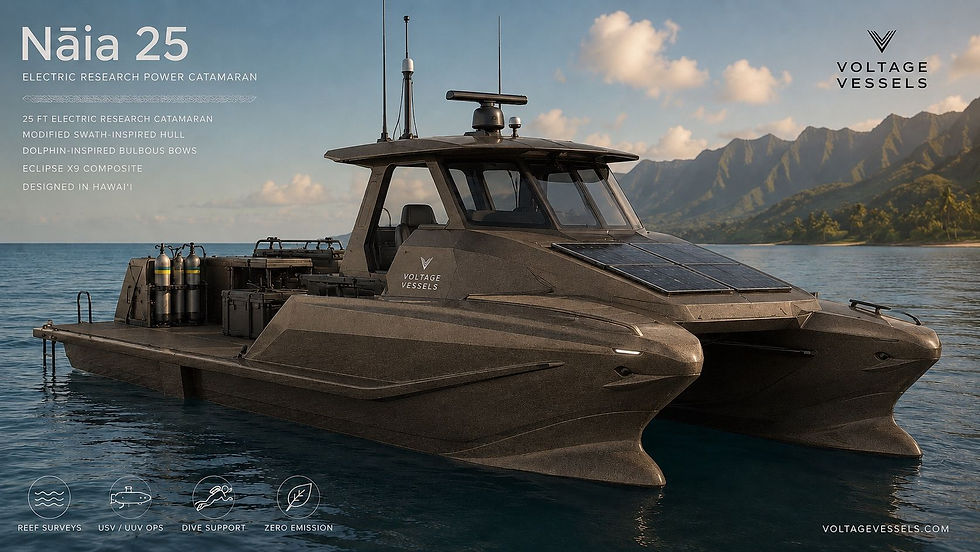
The company says the concept of "distributed manufacturing" is one of their primary goals behind the project. Rather than shipping finished boats or storing extensive inventories, manufacturers can potentially store digital files and produce structures where and when demand exists. While 3D printing of boat hulls is still in its infancy, the capability to build anywhere, quickly, and on-demand could completely reorganize the manfucturing supply chain.
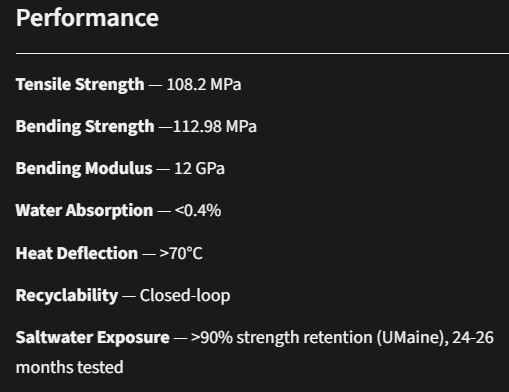
The Basalt material also differs significantly from traditional fibreglass construction. Basalt fiber is becoming increasingly common in industrial composite applications because of its corrosion resistance and chemical stability. When Voltage Vessels tested the fabric with the University of Maine Advanced Structures and Composites Center, the material retained more than 90 percent of its strength after more than two years of saltwater immersion while maintaining low water absorption figures. If the material proves seaworthy long-term, it could increasingly replace fibreglass as manufacturers adopt new methods to build boats not only faster, but also stronger and more weather-resistant.
The burdensome requirements of maintaining and storing moulds may also be welcomed by some of the industry's lower volume manufacturers and specialty builders where tooling costs represent a large percentage of the company's overall expenses. Building and stocking replacement parts could also change drastically as companies could build on a made-to-order basis, rather than keeping a large physical stock taking up valuable floor space. For some of the industry's largest manufacturers, it could also reduce the storage requirements for the countless moulds for each model that includes the hull, deck, and primary components like hardtops, stanchions, and structural supports.
As it stands, companies like Voltage Vessels are te first wave of potential wholesale changes to marine manufacturing. Their concept of additive manufacturing still has limitations compared to established recreational boat production methods, but that doesn't mean boaters shouldn't be paying attention, either.
While large-format printing is still relatively slow compared to established mass production processes, once industrial-scale printing becomes capable of producing full-size hulls, the potential for large scale change becomes possible. Right now, 3D printed structures require finishing and post-processing work, much like existing fibreglass methods, which adds a similar degree of labor to the manufacturing process. So while traditional fibreglass construction has decades of real-world operating history behind it, large-scale printed composite hulls could change how we approach marine manufacturing once the bugs are worked out.
For now, Voltage's six-metre (19'8") RIB will remain a defense project rather than a recreational product. But, as with many economic advancements in our history, they were adopted early by the military industrial complex before cascading into commercial manufacturing later on.
While any wholesale changes to recreational boatbuilding would be massive, complicated, and time-consuming, especially during the current period of larger economic turmoil, manufacturing boats from digital files rather than moulds presents an interesting idea for the future. Boaters like to go fast, and building boats even faster would certainly have its appeal. #news #culture


Comments