
The Fastest Boats in the World Pt. VII - Diesel Dominance


In Part 6 of this series, we got away from the exotic record-setting boats and began looking at waterjet-powered boats of all types and sizes. In Part 7, we will explore some commonly recognized record-breaking diesel-powered boats.
So, let's say you have an inflatable dinghy to go with your cruiser, or perhaps a larger Zodiac or RIB (Rigid Inflatable Boat) as your primary boat. Even with moderate horsepower, these lightweight boats are not only fuel efficient, but also adrenaline-pumping smile-makers when pushed – whether 10-feet long or 40-feet long.
As expected, UIM has several different categories in its “Pneumatic” class, with the first recording of top speed being in 1973 on Lake Windemere in England of 43 mph (69 km/h) in the C category with a 45 hp Penta outboard motor. Later that year, the same person recorded 57 mph (91 km/h) in D category with a 60 hp Penta.
Categories changed over the years but the fastest UIM world speed record I could find was recorded in 2016 in the R300 category by Peter Hart of Great Britain at 80 mph (129 km/h) with a Mercury outboard on a Mannerfelt RIB on Lake Coniston.

What is claimed to be the fastest RIB today is the 52'4" (15.9 m) Olsson and Bernico of Belgium, named the Bernico 52R - a custom carbon fibre Rigid Inflatable Boat. It is powered by twin Mercury Racing 1,550 hp engines with surface drives, plus hybrid power, producing a top speed of 120 mph (193 km/h).
Renowned performance boat designer Fabio Buzzi spotted a loophole in the rules of offshore racing. His discovery led to the development of the high-speed, lightweight, high-output Seatek marine diesel, which he installed in a Rigid Bottom Inflatable (RIB) of his own design. That boat quickly won many of UIM Offshore’s most prestigious races around the world. Buzzi's RIB utilized a drive of his own design – the Trimax trimmable surface shaft drive. Running a diesel-powered RIB, he was laughed at until he began not only winning, but winning consistently.

Buzzi's development of a diesel powered RIB provides a perfect segue from the world’s fastest RIBs to the world’s fastest diesel-powered boats. Buzzi played a major role in this, too - his FB Design set a world diesel speed record in 1978 of 110 mph (177 km/h) in UIM Class S4 in a three-point hydroplane of his own design. In 1979, he established a new world speed record for diesel engine boats at just under 120 mph (193 km/h).

In the late 1980s and early ‘90s, Buzzi built possibly his most famous boat, the diesel-powered CESA 1882 in Europe, which was renamed Gancia dei Gancia in the US. It amassed 17 consecutive offshore racing podiums of which 14 were first place finishes. It met UIM and APBA rules while also winning the gruelling Miami-Nassau-Miami race. Diesel engines were soon banned from Open Class (Class 1), so Buzzi switched to Superboat Class.
In the early 1990s, Buzzi showed up with arguably the first all-carbon fibre 55-foot (17 m) raceboat La Gran Argentina, with canard wings at the bow to counteract “stuffing” into a wave, an F-16 fighter jet derived escape capsule, and powered from four of his Seatek bi-turbo diesel inboards totalling 4,425 horsepower fed through his proprietary Trimax surface drives. The boat was a three-time World Superboat Champion in the mid-1990s.
In 2018, Buzzi broke his own World Diesel Speed Record he set in 1992 on Lake Como near his Milan studio. At 75 years old, Buzzi piloted an FPT (Fiat Powertrain Technologies) diesel-powered hydroplane to a new world diesel speed record of 172 mph (278 km/h). Fabio Buzzi set some 56 world speed records, won 52 world offshore racing championships, and won the Harmsworth Trophy seven times.

The earliest diesel speed record is arguably that of Germany’s Gert Lurssen in 1939 at 42 mph (68 km/h). Legendary racer Don Aronow is said to be the first to break 100 km/h (62 mph) in a diesel-powered Cigarette in 1967. Then came Fabio Buzzi in 1992 running 157 mph (252 km/h) with an 840 hp Seatek turbo-diesel, followed in 2018 by the current world diesel speed record of 172 mph by Buzzi as outlined earlier.
For those who love statistics, UIM official diesel speed records started in 1959 with a Perkins diesel running at 33 mph (52 km/h). The next significant record is that of Dick Bertram in 1965 in Brave Moppie recording 58 mph (93 km/h). Later in 1967, Don Aronow broke his earlier diesel-powered Cigarette record with a run of 64 mph (104 km/h) in his Maltese Magnum. Several official records were set by Renato Molinari and others in Italy, then finally by Fabio Buzzi at 172 mph (277 km/h).
Fabio Buzzi died in 2019, along with two others, in one of his offshore race boats when it hit a reef while turning into Venice harbour following the completion of an assault on one of his previous Mediterranean endurance records. He was 76 years old. I personally feel most fortunate to have interviewed Fabio while I was witnessing and reporting on an official UIM kilo-run V-bottom record-setting shootout on the Pamlico River at Reggie Fountain’s Washington, North Carolina headquarters in early 2004. My interview was very short, as Fabio was constantly engaged by Reggie and co-driver Ben Robertson, who set the new world V-bottom speed record that day at 172 mph (277 km/h) in his 42-foot “Cat Killer” powered by twin staggered 1,075-hp Mercury Racing engines.
That same World V-Bottom Speed Record held for ten years. In April 2014, Brian Forehand and Joe Sgro set a new World V-Bottom speed record on the same Pamlico River behind the Fountain Powerboats facility at 179 mph (288 km/h) in a 43-foot Outerlimits SV43 powered by twin Mercury Racing 1,650-hp engines. A short four months later, Outerlimits founder and president Mike Fiore died at age 44 when his 46-foot Outerlimits catamaran went airborne and crashed at just shy of 200 mph (322 km/h) during a speed record attempt at the Lake of the Ozarks Shootout.
The current world V-bottom speed record of 186 mph (299 km/h) is held by the Factory Billet Team of Jim Schultz and Mike Faucher in their 51-foot Outerlimits powered by twin roughly 2,000 hp engines set at the 2024 LOTO Shootout.
That’s it for V-bottoms. Now on to catamarans.
Offshore ocean racing in rough water started in England after World War II and seized on the development of the Deep-Vee hull design. Inshore racing, in smoother water, had gravitated to the tunnel hull and three-point hydroplane design of various sizes and power sources. Then, in the mid 1970s as offshore racing was gradually being run closer to shorelines to attract more spectators, Cougar Marine in England developed a stepped hull UIM Class 1 multi-hull (twin-hull air-entrapment catamaran) named Yellowdrama III. Made of plywood, it was designed exactly for this type of water. It won what is considered the world’s roughest offshore event: the famous Cowes-Torquay-Cowes offshore race. It also set a Class I speed record. The world of offshore boat racing took notice.

American racer and restauranteur Rocky Aoki bought Yellowdrama III and renamed it Benihana after his chain of restaurants. It set more speed records and became U.S. National champion. But, the rough pounding water was not kind to plywood hulls and so Cougar Marine started building catamarans from aluminum. Its first signature build was one of the biggest, fastest, and most visible boats on the offshore racing circuit, the 46-foot bright yellow Popeye’s/Diet Coke aluminum catamaran powered by four 700 HP MerCruiser sterndrives with Speedmaster outdrives. It was the first four-engine build for Cougar Marine and was commissioned by offshore racer and Popeye’s franchise creator Al Copeland for the new APBA Offshore Superboat category. Catamarans had gained offshore racing acceptance.

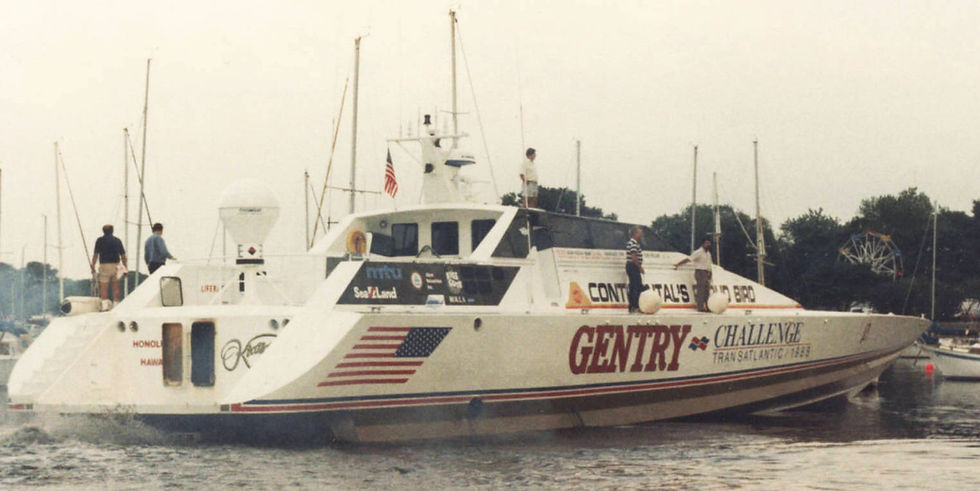
Then, in 1987, Tom Gentry of the ocean crossing Gentry Eagle fame mentioned earlier in this series, was the first to hold three offshore ocean speed records concurrently, thus earning him the title of Fastest Man in Offshore. In 1987, he set a world offshore Superboat Class speed record of 148 mph in his 48-foot Cougar catamaran powered by four of his own 1400 hp turbocharged Eagle engines coupled with two Gentry-designed surface drives. This was all advanced technology for 1987. Then, in 1994, he set a new Class 1 world offshore course speed record at over 157 mph.

Catamarans soon caught on as high-performance pleasure boats, just as vee-bottom boats had years earlier. Turbine power became available for both pleasure and racing. One of the fastest and most famous offshore race boats was the Miss GEICO 50-foot (15.2 m) Mystic catamaran powered by twin T-53 Lycoming turbines taking it to over 210 mph (340 km/h). Miss GEICO won five consecutive superboat world championships from 2006 through 2010.
Fellow BoatBlurb contributor and good friend Captain Bill Jennings and myself were in the cockpit and part of the setting of a very unofficial world speed record in the late 1990s of the “World’s Fastest Production Pleasure Boat.” We clocked 141.3 mph (227.4 km/h) in an off-the-shelf 40-foot (12 m) Skater catamaran powered by two of the brand new (at that time) Mercury Racing 900 SC (Supercharged) pleasure boat engines. World renowned offshore throttleman Bobby Moore was at the helm on the Intracoastal off Miami. That unofficial record has been broken many times since with Mercury Racing offering “off-the-shelf” production engines, which are now up to 1750 hp. With turbine engines available for pleasure boats, speeds surpassing 200 mph (322 km/h) are routinely available in pleasure boats.
The Lake of the Ozarks Annual Shootout has produced all four current catamaran category world speed records:
1) Turbine Power – 244 mph (393 km/h) in a 50-foot (15 m) Victory Catamaran, Spirit of Qatar
2) Piston Power – 221 mph (355 km/h) in a 50-foot (15 m) Mystic Catamaran, American Ethanol
3) Outboard Power – 136 mph (219 km/h) in a 32-foot (10 m) Doug Wright 320 Catamaran with twin Mercury Racing 450R outboards
4) Electric Power – 116 mph (187 km/h) in a 32-foot (10 m) S2 Catamaran with twin Vision Marine 180E engines
This annual Shootout is open to the public, as is the annual Desert Storm Shootout in Lake Havasu, Arizona.
Stay tuned to BoatBlurb for the concluding Part 8 in this series as we examine one of the most spectacular and fastest forms of speed on the water. #culture



Comments