
The Fastest Boats in the World Part VI - The Jets

By the end of Part 5 in this series, we established the current overall world water speed record set by Ken Warby in Australia in 1978 at 318 mph (511 km/h). We also outlined a few of the later unsuccessful and fateful challenges to that record. Those record-setting boats are all boats that you and I would never set foot in and likely would never see in action.
In Part 6, we are going to explore the more “domesticated” race and speed boats – boats in which you could participate if you so desired. Many have UIM classes that recognize world speed records for their class. Let’s start with jet boats.
So far, all of the boats mentioned in this series have been propeller-driven, except for the few jet or rocket-powered boats that were propelled forward by thrust from their engines. But for a long time now, we have had watercraft whose engine power was transmitted into speed via a waterjet. Personal watercraft (PWCs) are a perfect example. They are fun and can be fast, too.
Shallow water is the Achilles heel to a propeller. To solve this, Keenan Hanley of Prospect, Ohio designed a waterjet -- basically a centrifugal pump which would take water in one end and expel it out the other end at a greater speed. He established Hanley Hydrojet and partnered with Kermath Manufacturing of Detroit to adapt it for pleasure boat use. The Hanley-Kermath Hydro-Jet was coupled to an inboard engine, protruding only slightly below the hull, and was installed on a 17-foot runabout to hit the 1953 boat show circuit. It didn’t cause much excitement.

By 1954, Sir William Hamilton of New Zealand had been tinkering with the water jet idea. He modified the Hanley design to expel the water stream through a steerable nozzle above the waterline, thus removing any part of the waterjet from below the hull. This became the first Hamilton Waterjet. Hamilton Jet, along with several other water jet makers, have since grown and expanded to provide water jets to almost every sector of both pleasure boating and large commercial shipping. For example, the American Berkeley Jet Drive was introduced in 1960 and became dominant in high performance and racing, as we shall soon discover.
The first truly commercially successful jet boats were the 16 to 23-foot (5 to 7 m) Buehler Turbocraft models. Created in Indianapolis, Indiana under license from William Hamilton and introduced to the public in 1959, the Buehler Turbocraft featured a very shallow V-hull and was usually powered by a 250 hp Ford Interceptor V8 through a Hamilton 3-stage axial flow jet pump.

The boat was good for about 40 mph (64 km/h) and could operate in only 3" (8 cm) of water. An 18-foot (5.5 m) Buehler Turbocraft became famous for navigating the Colorado River through the Grand Canyon in 1960. In 1965, one was featured in the James Bond film Thunderball. Laying dormant for several decades, the brand has just recently been revived to build luxury runabouts and yacht tenders.
Meanwhile, Dowty Canada was part of the British engineering conglomerate that specialized in aerospace, electronics, fuel systems, andhydraulics. In the late 1950’s, Dowty UK licensed with Hamilton Jet of New Zealand to build the small 14'6" (4.4 m) Dowty Turbocraft runabout on a narrow 5'9" (1.8 m) beam in both England and in Ajax, Ontario. It was powered by a 75 hp 2.5 L Ford Zephyr 6-cylinder engine through a 2-stage Hamilton jet. It was sold in Canada and the Eastern United States.
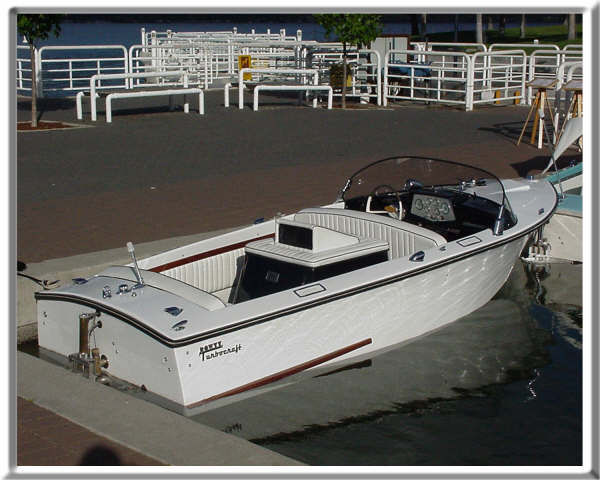
The boat was capable of maybe 40 mph (64 km/h) on a good day. I know because I have run a couple of them and sold a few used ones in my day. It could stop on a dime (throw it into reverse at any speed) and turn on a dime (cut the throttle, turn the wheel to full stop, and then jump on the throttle), but don’t do any of this with anybody else on board or you lose them overboard. It was not good practice at all, and I do not recommend it, but as boat dealers we always said there is no such fun on the water like a Dowty jet boat.

1975 Chrysler Conqueror & Pick-Up / Photo - Hot Rod Magazine 
A restored 1975 Chrysler Conqueror / Photo - Hot Rod Magazine
One of the most prevalent and best selling jet boats of this era was the 1970s Chrysler Conqueror, which came in many versions from 16' (5 m) to eventually 21' (6 m). This was during the heyday of the muscle car era, and it was Chrysler’s version of the 'muscle boat.' It sold well. With its Mopar power 340-CID V8 coupled to a Chrysler-designed jet pump, it was indeed a muscle boat to be reckoned with. With a very shallow V-hull it had almost instant acceleration and its dual thru-hull exhausts let everyone know it was coming – and going.

But, just before the Chrysler Conqueror in 1968, recreational fun on the water changed exponentially when Canadian company Bombardier took the overwhelming success it had on snow with its Ski-Doo line and transfered the same principles to the water. Enter the first Sea-Doo, which was not necessarily the first sit-down PWC. That honour most likely goes to the Vincent Motorcycle Company in Great Britain who produced the Vincent Amanda propeller-driven Water Scooter, or "Boater-Cycle" for a short few years in the mid-1950s. It was powered by a single cylinder 75 cc air cooled 2 hp engine with a centrifugal clutch and reached the astounding speed of 15 mph (24 km/h).
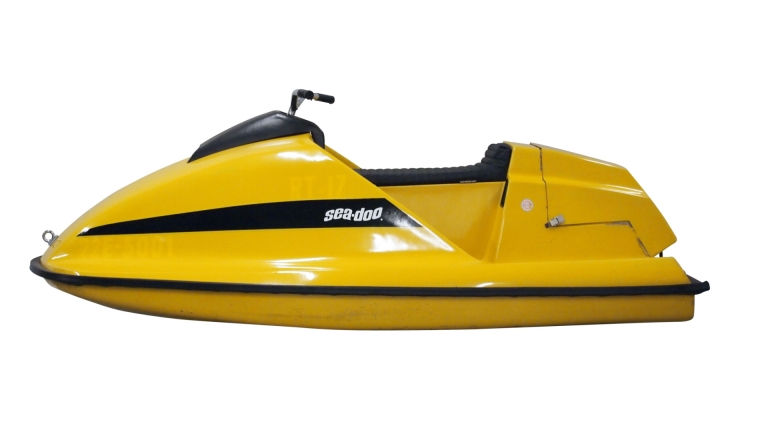
Now, back to the Sea-Doo. It was powered by a 320 cc Rotax single-cylinder air-cooled engine producing 18 hp reaching and a top speed of roughly 25 mph (40 km/h). It utilized not a Hamilton but a Berkeley Jet Drive connected via four V-belts to the Rotax. Engine cooling and slipping V-belt problems plagued the first Sea-Doos and production soon ceased, but it was the first mass-produced Personal Watercraft (PWC) and signified the start of a whole new industry. Sea-Doo lay dormant for 20 years until was relaunched in 1988 after Yamaha had entered the sit-down PWC market with its first WaveRunner in 1986.
Then, in late 1972 came the first stand-up personal watercraft (PWC) - the Kawasaki Jet Ski JS400 - with motorcycle-style handlebars to portray the feeling of a motorcycle on the water. It was powered by a high revving 400 cc water cooled inline twin cylinder 2-stroke engine with stainless steel water jacketed exhaust pipe feeding into a Kawasaki-designed single stage axial flow aluminum water pump with a 3-blade aluminum impeller. The Jet Ski was the start of the stand-up PWC market which has continued to this day with Kawasaki and Yamaha as the industry leaders.
Now, with the foundation of jet boat technolody laid, let’s take a look at jet boats and their top speeds. Both stand-up and sit-down PWCs are grouped together as the “Aquabike” category in UIM world water speed record keeping. A 700 cc Yamaha recorded the first official Aquabike world speed record in France in 1993 at 45 mph (73 km/h). Later that year in France, Kawasaki upped that record to 55 mph (88 km/h).
In 1999, Bombardier Sea-Doo in England upped that record to 66 mph (106 km/h). In 2002, in Georgia, USA, Yamaha claimed 76 mph (123 km/h). Kawasaki ran 81 mph (130 km/h) in England in 2008 in a larger displacement engine category. Finally, in 2015, the highest Aquabike UIM speed recorded in England happened on Donald Campbell’s tragic Coniston Lake in Superstock Class at 88 mph (142 km/h). As we shall discover next, these speeds do not do justice to what jet boats can do. The fastest current production PWCs on the market can approach 0-60 mph (97 km/h) acceleration in under four seconds with top speed around 70 mph (113 km/h).
Starting in 1960, Berkeley Jet Drive pushed to achieve the 100 mph mark (161 km/h) with water jet propulsion. Its first record that same year was 40 mph (64 km/h) in a 15-foot (4.6 m) plywood boat. The 100 mph (161 km/h) Berkeley jet drive speed barrier was broken in 1970 in California. Meanwhile in the mid-1960s, UIM had created a world water speed record class for 1/4 mile drag boats with sub-categories for “inboard” and “outboard," for “gas” and “fuel,” and for “unblown” and “blown,” referring to naturally aspirated, supercharged, or turbocharged engines.
As you might guess, the 1/4 mile distance for drag racing on the water was an idea brought over from the popular distance of drag racing on land. Today, there are three popular drag racing distances for boats: 1/8 mile, 1/4 mile (mostly for unlimited class boats), and an increasingly popular distance of 1000 feet which is roughly 3/16ths of a mile. Suffice it to say that in 1976, a National Drag Boat Association jet drive UIM record was set at 140 mph (225 km/h) in the 1/4 mile in Long Beach, California.
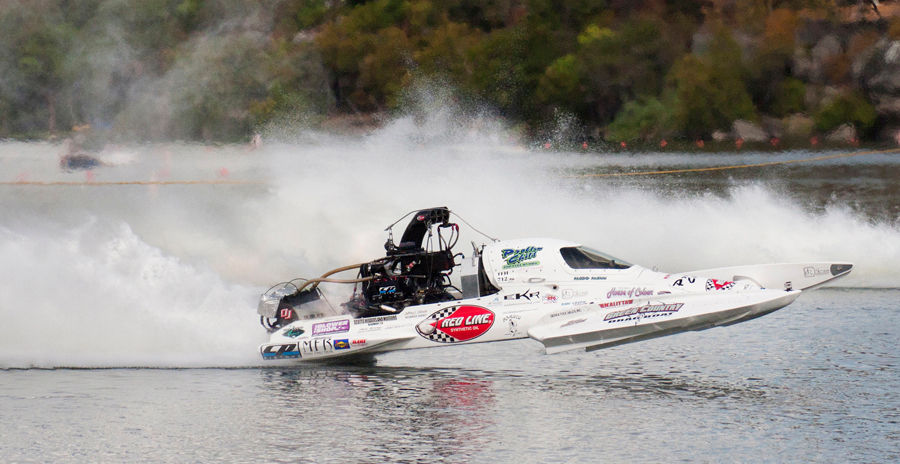
The National Jet Boat Association (NJBA) in the United States has seven classes of water jet propelled drag racing boats. Today, Unlimited and Top Eliminator blown fuel drag boats can cover the 1/4 mile on water from a slow rolling start in roughly three seconds with a top speed of around 270 mph (434 km/h). One such Top Fuel Hydro(plane), Problem Child, powered by a supercharged 500-CID Hemi engine producing up to 8,000 horsepower through twin propellers, set a 1000-foot drag racing mark in 2011 of 260 mph (418 km/h ) in 3.36 seconds!
The Jet Boat Racing Canada (JBRC) association has four classes of water jet propelled boats specifically designed for river racing at up to 160 mph (257 km/h). Once again, the classes are mainly distinguished by engine size, fuel, and aspiration. Boats are minimum 16-feet long (5 m) and constructed of aluminum.
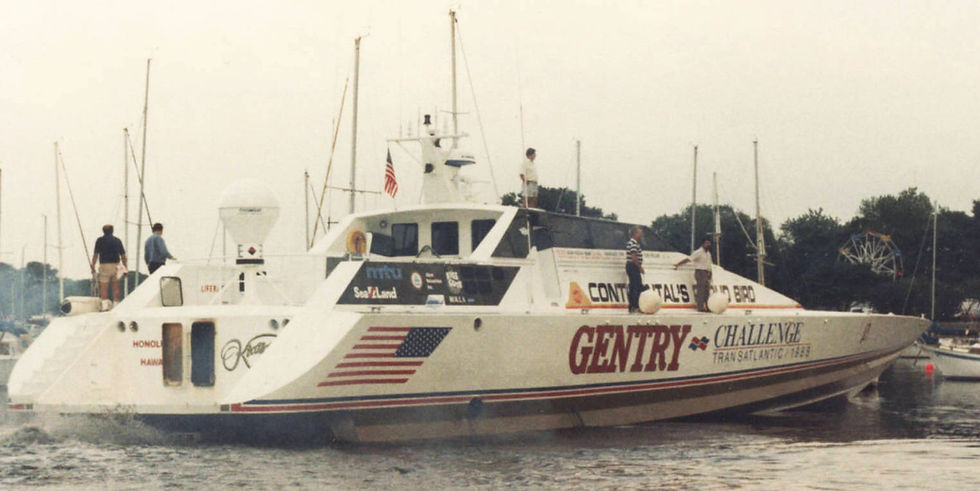
Now, when you are blasting along on your PWC powered by a waterjet you may be unaware of the scope of waterjets, so here are a couple of larger examples. The first is the 112-foot (34 m) Gentry Eagle powered by twin MTU diesels of 3,480 hp each through twin Swedish KaMeWa waterjets, plus a 4,500 gas turbine feeding an Arneson surface drive mounted between the two waterjets. The Gentry Eagle claimed the Blue Riband trophy for the fastest crossing of the Atlantic Ocean in 1989. It was capable of almost 80 mph (129 km/h) top speed.

The second is the Francisco, apparently the Australian built world’s fastest high speed car and passenger ferry and the first to be powered by liquefied natural gas (LNG). At 325 feet long (99 m), it utilizes a pair of Wartsila waterjets to attain its amazing top speed of 67 mph (108 km/h). It is in service between Uruguay and Argentina.

Closer to home here in Canada and the Whirlpool Rapids of the Niagara River below “The Falls” are tour boats powered by waterjets. The newest 64-passenger boat features triple Scania turbo-diesel engines of 700 hp each feeding into three waterjets giving it a maximum speed of just under 60 mph (97 km/h).
In Part 7 of this Fastest Boats in the World series, we will continue to examine the different types of the "fastest boats" available on the market and, like the jet boats of this article, offer some super thrills and incredible top speeds.



Comments