
Recreational Boat Builders Expand Into Defense Contracts as Demand Grows for Military and Autonomous Vessels


Brunswick Corporation, Nimbus Group, and Mystic Powerboats have all recently signed agreements with defense contractors.
Several recreational boat manufacturers in the U.S. and Europe have recently secured defense-related contracts and partnerships, marking a growing trend between marine manufacturers and the defense industry.
In the U.S., Illinois-based Brunswick Corporation and Florida-based Mystic Powerboats both recently announced agreements to offer their expertise in the manufacturing and development of autonomous military vessel programs. Brunswick owns several leading boat brands in the industry including Sea Ray, Boston Whaler, Lowe, and Princecraft. The company also owns propulsion company Mercury Marine and electronics manufacturer Simrad.
Mystic Powerboats is a well-respected builder of high-performance powerboats known for custom catamarans, center consoles, and luxury performance designs. Founded by John Cosker, the company has a stout reputation in the boating community for combining offshore racing heritage with advanced engineering and premium craftsmanship.
Meanwhile, in Europe, Sweden's Nimbus Group has begun production on a contract to build 200 high-speed vessels for the Swedish Armed Forces. Nimbus Group owns eight major European brands including the namesake Nimbus lineup, as well as Paragon, Alukin, Aquador, Flipper, Falcon, and Bella. They also own Florida-based center console manufacturer Edgewater Powerboats.
Brunswick Corporation announced in May that its boats, along with Mercury Marine propulsion systems and Navico Group electronics, will be provided for Textron Systems TSUNAMI uncrewed surface vessels. The news followed Textron being awarded a contract from the Defense Innovation Unit (DIU) of the U.S. military. The vessels are being used by the U.S. Navy Fourth Fleet and U.S. Southern Command (SOUTHCOM).

According to Brunswick, multiple TSUNAMI USVs participated in the U.S. Navy's Fleet Experimentation exercise in Key West, Florida, earlier this year and will be supporting three months of joint operations with SOUTHCOM and the U.S. Navy's Fourth Fleet. The modular autonomous platforms were developed through collaboration between teams of engineers at both Brunswick and Textron. Sea Ray, one of Brunswick's brands, has a manufacturing facility in Merritt Island, Florida.
Photo - Textron Systems Photo - Textron Systems Photo - Textron Systems
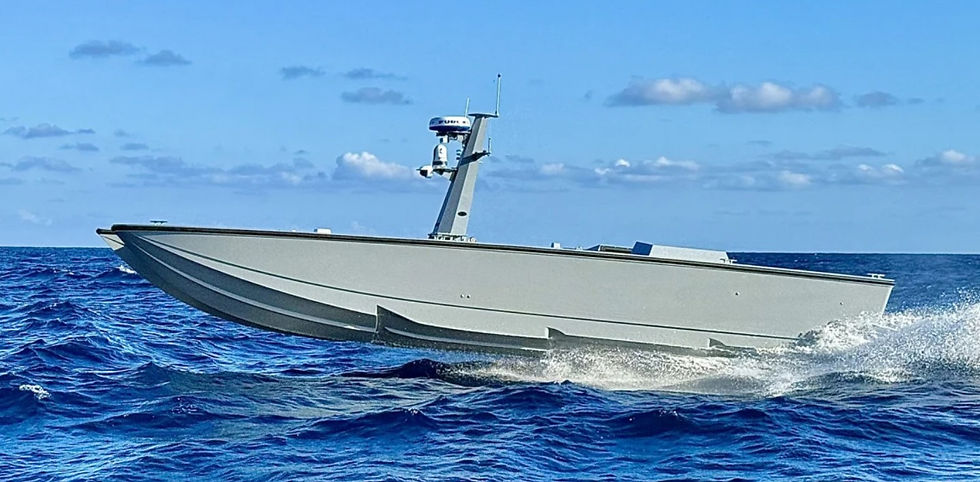
The TSUNAMI platform is made in configurations ranging from 21 to 38 feet (6.4 to 11.5 m) with a modular template for flexibility depending on operational needs. The platform can carry payloads of up to 5214 pounds (2365 kg) and is capable of speeds exceeding 50 knots (93 km/h or 58 mph).
"Brunswick, the world's largest recreational marine technology supplier and boat manufacturer, with a large U.S. manufacturing base, brings together a broad portfolio of boats, propulsion, advanced marine electronics, and control systems into a unique integrated package and we're applying that capability to help enable the next generation of assisted and autonomous capabilities on the water," said CEO Dave Foulkes in a press release in May.
The program will combine Brunswick's hulls, propulsion systems, and manufacturing capacity with Textron's autonomy technology to build modular vessels intended to meet the U.S. military's growing demand for unmanned capability at sea.

At nearly the same time, Florida-based Mystic Powerboats signed a co-production agreement with autonomous vessel developer MARTAC. Announced last week, the partnership will expand domestic manufacturing capacity for MARTAC's autonomous surface vessels (USVs) by using Mystic's carbon fiber manufacturing expertise to meet the growing demand from U.S. and allied customers.
Similar to Brunswick's agreement with Textron, Mystic said the arrangement with MARTAC combines its composite manufacturing expertise with MARTAC's autonomous systems technology. According to both parties, the agreement is the first in a broader forthcoming co-production framework designed to increase surge capacity and diversify their supply chains when short-term demand spikes.
"Our partnership with Mystic represents a significant step in scaling our ability to deliver autonomous systems at the speed required by today's operational environment," MARTAC founder and chief executive Bruce Hanson said in a press release. "By combining our proven autonomous capabilities with Mystic's world-class composite manufacturing expertise, we're building a resilient, distributed production model that strengthens both capacity and responsiveness."
The Mantas T12 The Devil Ray T18
MARTAC is already known in defense circles for their MANTAS X-Class and Devil Ray Expeditionary Class platforms. The Devil Ray T18 carries an LOA of 19'8" with a max payload of 750 lbs and a top speed over 60 knots via twin inboard gas engines. The smaller Mantas T12 carries an LOA of 12' with a max payload of 140 lbs and a burst speed over 30 knots from an electric powertrain.
Mystic Powerboats founder and president John Cosker said the company viewed the partnership as an opportunity to apply its manufacturing capabilities to defense applications.
"Mystic has spent decades pushing the limits of high-performance composite boatbuilding, and this partnership allows us to bring that expertise to a new mission," Cosker said in the release. "We're proud to support MARTAC and contribute to technologies that enhance maritime security and operational effectiveness."
Similar developments are taking place in Europe.
Sweden-based Nimbus Group announced in April it received its first order from the Swedish Armed Forces for 60 MSMB 200 workboats valued at approximately SEK260 million ($27.3 million USD). Deliveries are scheduled to begin in January 2027 and continue over a 36-month period.

The 36-foot (11 m) aluminum vessel was developed jointly with Svensk Konstruktionstjänst (Svekon) after both companies won a public procurement tender in 2024. The framework agreement provides for serial production of up to 100 boats and spare parts, with Nimbus estimating the maximum value of the program at up to SEK400 million ($41.8 million USD) over 15 years.

The MSMB 200 is based on an aluminum hull originally developed under Nimbus Group's Alukin brand as the Alukin CW 850. The standard civilian version is rated up to 450 horsepower with a top speed of 40 knots (46 mph). The military iteration is modified and adapted for its specific use case and is configured to carry two primary crew members and up to eight passengers and gear. The boat carries a max payload of 1.2 tonnes (2600 lbs).
The Alukin CW 850 The Alukin CW 850 The Alukin CW 850
"The MSMB 200 builds on our existing capabilities in advanced product development and serial production," Nimbus Group president and chief executive Johan Inden said in a statement.

"The order paves the way for expanding our business within the growing market for various types of workboats. This segment is particularly attractive as it offers long-term contracts and large production volumes and is significantly less sensitive to temporary economic fluctuations. Nimbus Group intends to further explore the substantial opportunities in this segment,” he added.
The company delivered the first military-edition boats earlier this year in partnership with Svekon after the platform completed sea acceptance trials with the Swedish Security and Defence Industry Association (SOFF).


Comments