
Lake Michigan Shipwrecks - Different, Dangerous, & Dramatic

Updated: Jan 25

Lake Michigan, one of the five Great Lakes, is quite unlike the other four. It is the third largest of the five by surface area but second largest (only to Lake Superior) by volume. That is because it is deep with an average depth of 280 feet (85 m) and a maximum depth of 925 feet (282 m).
It is the only Great Lake that is entirely within the United States and, as such, it is the largest lake in the world by surface area entirely within one country. It is bordered by Michigan, Wisconsin, Illinois, and Indiana. The sand dunes on the east shore of the Lake, sometimes up to hundreds of feet high, are the largest freshwater dunes in the world.
It is also different in that it is the only Great Lake not connected to another Great Lake by means of a river. In fact, the Straits of Mackinac that are roughly 30 miles (50 km) long, three miles wide at the narrowest point and up to 295 feet (90 m) deep, is hardly a river and connects Lake Michigan to Lake Huron with no change in elevation. Because of this, many argue that Lake Michigan and Lake Huron are actually one big lake. And similar to Lake Huron having its Georgian Bay, Lake Michigan has its Green Bay, separated on the northwest side of the Lake by the delightful and tourism-rich Door County peninsula.
The five-mile long vehicle bridge over the Straits of Mackinac took over three years to complete and was the world’s longest suspension bridge between anchorages when it opened in 1957. The bridge became a godsend for vehicle traffic connecting the Upper and Lower Peninsulas of Michigan and an east-west driving shortcut. The entire region around the Straits is known as Michilimackinac from the Ojibwe word meaning “Place of the Great Turtle.”
The French shortened this mouthful to Mackinac, with the “c” being silent and the English then changed the “c” to a “w” as a phonetic aid in pronunciation. As such, places like the Straits of Mackinac and Mackinac Island retain the French spelling while Mackinaw City took on the English spelling. They are both pronounced the same with the “c” being silent. There is still the reconstructed Fort Michilimackinac with the full name when it was built by the French in 1715 for the fur trade. It has a very rich history including its role during the War of 1812 between Canada and the United States.
Now, back to Lake Michigan and its shipwrecks. Yes, like the other Great Lakes, Lake Michigan also claims to be the Graveyard of the Great Lakes. It certainly has its share, including some of the worst for loss of lives. Like Lake Erie, Lake Michigan is said to be the final resting place of up to 1500 wrecks. And again like Lake Erie, roughly three hundred have been documented.
Lake Michigan is not shallow and full of shoals and islands like Lake Erie, so why is it the cause of so many sinkings? It is long and open at 307 miles (494 km) long by 118 miles (190 km) wide at its widest point, thus making itself open to strong mid-west winds that create massive and powerful waves along that reach. In addition, the Milwaukee Reef divides the Lake into northern and southern basins, each with its own clockwise flow of water. With strong wind, waves, and especially strong currents, it all adds up.
Add to that the growth of Chicago as the hub of commerce in the Midwest. As the largest city on the Great Lakes, and with a connection by water to the Mississippi River and the Gulf of Mexico, it encourages a preponderance of shipping, which in turn has made Lake Michigan the busiest of all the Great Lakes. When you add the industrial might of Milwaukee on the lake just north of Chicago, and the steel mills of Gary, Indiana at the bottom, it is easy to visualize the massive volume of commercial shipping. More shipping means more accidents.

The first substantial ship to sail the Great Lakes, the barque Le Griffon was built by Sieur de La Salle on the Niagara Peninsula with the ultimate objective of finding a Northwest Passage to the Orient for France. The Le Griffon also became the Great Lakes first and oldest recorded shipwreck in 1679. To this day, no one knows what happened or where it may be. It vanished, along with six crew members and a load of furs, somewhere in northwest Green Bay.
This next one, although technically not a Lake Michigan shipwreck as it occurred just upstream in downtown Chicago on the Chicago River, it is the deadliest wreck in Great Lakes history. In July, 1915, the 265-foot (81 m) passenger ship SS Eastland had just finished loading its capacity of over 2,500 passengers, mainly Western Electric employees on a company cruise, and while still tied to its wharf, rolled over onto its side in 20 feet (6.1 m) of water.

The lateral stability of the ship had been severely compromised beyond its design over the previous number of years due to changes made to its hull bottom to allow for increased speed. Many extra tons of extra weight, including concrete floors, were added to its topsides. Also, additional heavy lifeboats were added on its upper decks as a result of new regulations following the sinking of the Titanic the previous year. In all, 835 lives were lost in the tragedy.
Named after the wife of Canada’s Governor General Lord Elgin, the sidewheel steamship Lady Elgin was considered one of the premier first class passenger ships on the Great Lakes. It regularly plied between Buffalo, Chicago and Collingwood. In September of 1860, it became the deadliest shipwreck in open water in Lake Michigan history. Returning from Chicago to Milwaukee in the late evening, with all its cabin and deck lights showing making it highly visible, but running in a violent gale, it was rammed hard by the timber schooner Augusta, opening a gaping hole in its side below the waterline.

Despite valiant attempts to patch the hole, the Lady Elgin went down quickly with a loss of an estimated 300-400 lives. Some lives were saved. An investigation resulted in the requirement for sailing vessels to show running lights at night – despite the fact it would not have prevented the accident. The sinking occurred just north of Chicago off Port Clinton (now Highland Park), but the wreckage was not discovered until 1989 in 60 feet (8 m) of water.
Lake Michigan has its “ghost ships,” too. The most famous is the 124-foot (38 m) three-masted lumber schooner Rouse Simmons. Known as "The Christmas Tree Ship" as it regularly supplied Chicago with Christmas trees from Michigan’s Upper Peninsula, the owner sold trees off the boat for up to a dollar each or gave some away to needy families. Each year, the schooner was decorated with Christmas lights and a lit tree was placed atop her mast.

In November, 1912, loaded with over 5000 Christmas trees, the Rouse Simmons, along with its crew of five plus eleven passengers, were lost in a violent gale. Christmas trees were spotted floating all over the lake. Of all the people lost and their belongings, only the captain’s wallet has ever been found -- in a fisherman’s net 10 years later. The ship itself was found in 1971 in 165 feet (50 m) of water, halfway between Kewaunee and Two Rivers, Wisconsin. Christmas trees are still well preserved in her hold. Sailors still preserve the “Ghost Ship” image by talking of seeing a schooner lit with Christmas lights passing through the mists.
November 11th, 1940 was Armistice Day in Commonwealth countries, also known as Remembrance Day here in Canada. On that day, a violent storm on Lake Michigan claimed two ships -- the 420-foot (130 m) ore and coal carrier William B. Davock was lost off the east coast of the lake with all 33 crew. The 380-foot (120 m) bulk carrier Anna C. Minch foundered and broke in two in the same area and sank off Pentwater, MI with the loss of all 24 crew. The November 11th storm was said to be the worst the Lake had ever witnessed since the infamous 1913 storm known as the White Hurricane.

Two other shipwrecks of note include the 350-foot (110 m) train ferry Pere Marquette 18, which regularly crossed the lake and sank in September, 1910 with a loss of 27 of its 62 passengers and crew along with a full load of 29 rail cars. The wreck was discovered in 2020 in 500 feet (150 m) of water some 25 miles (40 km) east of Sheboygan, WI.
Another train ferry, the 338-foot (103 m) Milwaukee, regularly ran between the Grand Trunk rail yards in Milwaukee, WI and Grand Haven, MI. In October, 1929, loaded with 27 rail cars, lumber, perishable foods, bathtubs, and Nash automobiles, it headed out into a horrendous Lake Michigan storm. Some of the cargo broke loose causing damage to the stern gate which allowed volumes of water to flood the ship. It was lost along with all 52 persons on board. The wreck was located in 1972, just three miles offshore and some seven miles north of Milwaukee, Wi. One can't help but wonder the status of the now classic Nash automobiles.
At the opening of this article, I mentioned about Lake Michigan being different from the other Great Lakes. Well, its shipwrecks are somewhat different, too. And that’s in part to the addition of UC-97, a 186-foot (57 m) World War I German mine laying submarine. U-97 was surrendered in 1918 and self-powered across the Atlantic and down the St. Lawrence Seaway to Chicago where it was moored as a tourist attraction for the sale of Victory Bonds. In 1921, by agreement with Germany, its basic hull was used for target practice by Navy Reservists. It was quickly sunk 23 miles (37 km) off Highland Park, Illinois. It has never been found.

Furthermore, there are an estimated 300 World War II US Navy planes on the bottom toward the middle of the Lake. These planes include Avengers, Thunderbolts, Wildcats, Corsairs, Vindicators, Texans (Harvards), Hellcats, and Dauntless dive bombers, all US Navy aircraft carrier based planes. But why in Lake Michigan?
After the Pearl Harbor disaster in December, 1941, the U.S. military quickly realized it needed thousands of pilots trained for carrier oriented missions. Both the Atlantic and Pacific coastlines were patrolled by the enemy, so Lake Michigan was chosen to provide a safe base for training. Getting an aircraft carrier into the lake was impossible, so the Navy purchased a used paddlewheel passenger ship, removed its superstructure, and added a short 550-foot (168 m) flight deck which extended well beyond each end of the ship. Aircraft arresting gear was added and voila – a freshwater aircraft carrier.
The program was so successful that in spring 1943, a second used sidewheel passenger ship was also converted. Takeoffs and landings happened at a near constant pace every day as each pilot was required to execute eight successful flights from a moving carrier before being sent overseas for duty. By the end of the war, over 15,000 carrier pilots were trained on these makeshift ships in Lake Michigan. One of those graduates was future US President George H. W. Bush. Both ships were able to dock at Chicago’s Navy Pier for restocking or for downtime. Several of the downed planes have been recovered and restored and are now in various museums.

Like Lake Ontario, Lake Michigan is also said to have its own Bermuda-type “Triangle,” although its origins and accuracy are disputed. It takes up a good portion of the open water and stretches south on the eastern shore from Ludington to Benton Harbor and then across to Manitowoc, Wisconsin. There is no accurate count of shipwrecks within the Triangle and not necessarily a proportionately greater number than anywhere else on the lake. There are no particular mystery shipwrecks either. It doesn’t seem to be a “normal” Triangle.
A commercial airliner did, however, disappear within the Triangle. In June, 1950, what became the worst air disaster up to that time in the US, involved the disappearance of Northwest Orient Flight 2501 from New York City to Seattle. Very little debris and human remains were recovered and nothing except some seat upholstery of the four-engine DC-4 has ever been found even though searches have continued into 2025. All 58 lives aboard were lost.
Although not particularly even close to the Triangle, a Strategic Air Command Boeing B-52 Stratofortress crashed in January, 1971 into the Lake off Charlevoix, MI while on a low-level training flight. All nine crew members were lost and no human remains were ever recovered while some aircraft parts were recovered from 225 feet (69 m) of water later that year.
To end the discussion of the differences of Lake Michigan, it is necessary to point out that the Lake has its own “Stonehenge.” Some 40 feet beneath the surface near Grand Traverse Bay is an outer and inner ring of stones, plus a line of stones over a mile long all determined to be roughly 9000 years old. This makes it one of the oldest structures ever discovered in North America. Some of the granite stones have elaborate carvings of animals and vary in size from a soccer ball to a small automobile. Discovered only 10 years ago, research is ongoing.
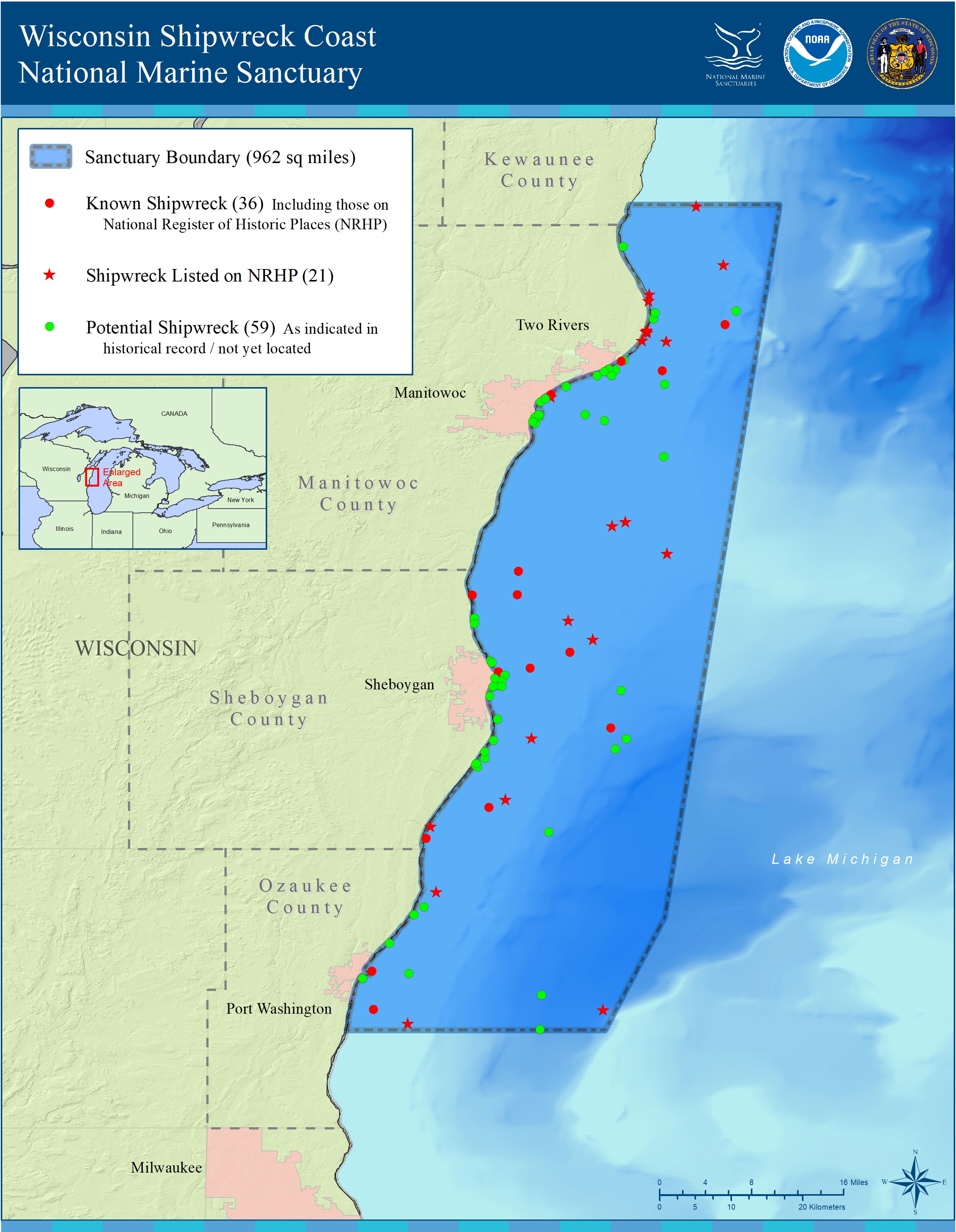
To recognize the historical significance of shipwrecks as well as their place as memorials to those lives that were lost with them, the Wisconsin Shipwreck Coast National Marine Sanctuary was created to protect the status and remains of the 36 known out of a potential of 60 shipwrecks in the protected area off the Wisconsin coast. 21 of the known 36 shipwrecks are listed on the National Registry of Historic Places. The State of Michigan has created 12 Underwater Preserves to protect dozens of shipwrecks from plundering.
Lake Michigan will always remain one of the greatest of all five Great Lakes for pleasure boating, but it demands a broad understanding of its power, and its hidden dangers, in order to enjoy its overwhelming beauty. #culture


Comments