
From Alberta to the Atlantic... to Morocco?

Updated: Mar 23

We finally know where he was headed.
But we may never know why. The saga of From Alberta to the Atlantic has followed the unbelievable story of 31-year-old Mohammad Saleh, a convicted criminal who embarked on an insane journey from Alberta to the Northern Atlantic by way of a stolen truck, a stolen boat, and some serious audacity.
In a case defined by unanswered questions, Saleh, a resident of Toronto but with ties to British Columbia and Alberta, stole a yacht from a small marina on Cape Breton Island only to be rescued adrift near Sable Island -- the infamous Graveyard of the Atlantic. One of the biggest unanswered questions surrounded why Saleh not only stole the vessel, despite having no boating experience, but also where he could possibly have been headed.
Thanks to great coverage from CBC, it has finally been revealed: Saleh says he was trying to reach Morocco.
Yes — Morocco.
A distance of roughly 5000 kilometres, or 3100 miles.
In a boat named Getaway.
By now, the outline of the saga is familiar.
On September 23rd, 2025, a man later identified as 31-year-old Mohammad Yazed Saleh arrived at the Lennox Passage Yacht Club in D’Escousse, Nova Scotia, a tiny coastal community on the southeastern corner of Cape Breton Island. There he ditched a stolen pickup truck, stole a cabin cruiser, and took off, setting off what would become a multi-agency search spanning thousands of kilometres.
Five days later, on September 28th, the vessel was spotted near the French territory of Saint-Pierre and Miquelon, some 350 kilometres northeast of Cape Breton Island. Authorities lost its track, but found it again two days later on September 30th near Sable Island, a peculiar backtrack of some 400 kilometres back to the southwest.
By that time, the vessel was seemingly adrift. Saleh was arrested onboard after having run out of fuel or suffering mechanical trouble, ending a voyage that was as dangerous as it was perplexing. He was returned to Nova Scotia to face charges. His rescue involved every maritime law enforcement agency in Canada -- the Department of Fisheries and Oceans Canada (DFO), the Joint Rescue Coordination Centre (JRCC), the Canadian Coast Guard (CCG), and the RCMP’s Marine Security Enforcement Teams (MSET).
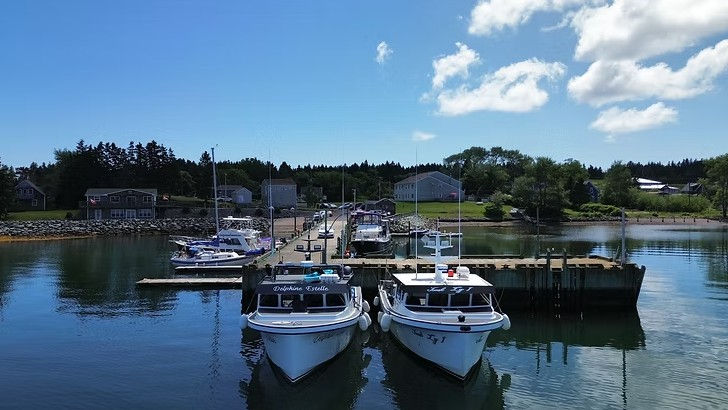
As authorities began retracing Saleh's steps, each discovery led to more questions. Why the stolen pickup truck? Why did it have Ontario license plates but was registered in Alberta? Why did he choose D'Escousse, which is nowhere near any conventional route? What drove him to flee Alberta? What was he up to in Ontario? How did he expect to cross the Atlantic?
In court proceedings, Saleh's only input on the matter was that he claimed to be “in fear of my life.” According to CBC, Saleh said he feared returning to both Alberta and British Columbia, where he faced outstanding warrants and other legal issues, including weapons-related charges dating back to 2023. He also claimed he feared repercussions from an unnamed business associate. In a back-and-forth with the judge before being cut off by his legal aid lawyer, Saleh said he “took a half-a-million-dollar loss out there. I had a big business and I left in fear of my life.” He also said a man in Edmonton helped him with a car restoration business until the relationship turned sour, but authorities never found any evidence to match the claim. They also found no connections to organized crime, despite Saleh claiming they were involved. Saleh also has a prior conviction for theft in Ontario from roughly a decade ago.
He originally faced 17 charges related to the boat theft, as well as outstanding warrants for vehicle theft and weapons offences in Alberta and British Columbia, and charges for being at large and breaching release conditions. In the end, Saleh's charges were reduced and he plead guilty to a charge of theft and possession of stolen property. As part of the deal, he was sentenced to time served, which amounted to roughly eight months of incarceration until he was freed last week.
In his final provincial court appearance in Port Hawkesbury on March 9th, a pre-sentencing report was read along with an agreed statement of facts. Saleh was given an opportunity to address the court.
In a twist of irony, Keavin Gallant Finnerty, the Nova Scotia Crown prosecutor, said Saleh told the RCMP he chose the boat named Getaway precisely for its name.
The cabin cruiser he stole was typical among East Coast boaters, featuring what's known as a 'Downeast' design with an enclosed pilothouse akin to the thousands of lobster boats working Atlantic waters. The popular boat shape makes for an excellent hybrid between a serious fishing platform and a family cruising vessel. Even with its workman-like appearance, Downeasters are commonly outfitted with the creature comforts of a yacht -- a sleeping berth, a galley, and the capability to withstand the harsh East Coast weather.
But that doesn't mean they're made to cross the Atlantic.
Saleh's public defender Adam Rodgers, told CBC, "(h)e would have been facing some extremely rough seas. That time of year, it's hurricane season off the Atlantic."
"It would have been a very dangerous thing to continue … and I'm not sure he even had enough fuel to get there, so he probably would have been stranded at some point in the middle of the ocean."
"I think he probably did well for a non-sailor to make it as far as Sable Island," Rodgers added to the CBC.
"He was rescued by the coast guard, for which he was grateful, but by his own account, he was running low on resources and he thought maybe another couple of days and he would have been in serious trouble."
Saleh told the court, "I'm trying to take responsibility for what I did." He said that after his release he wants to stay in Nova Scotia. He has a wife and three children.
"I just want to start all over again. From what I know right now, you guys are nice people. I think I'll stay here." #news



Comments