
Estimating Boat Fuel Consumption: A Practical Guide for Boaters

By: Koushik Paul

Fuel consumption is one of the most common questions boaters ask and one of the hardest to answer precisely.
Ask two owners of the same boat how much fuel they burn and you might get two different numbers. That is because fuel burn depends on several variables working together, including boat size, engine horsepower, hull design, speed, and load.
While onboard fuel-flow sensors provide exact numbers, most boaters simply want a reliable way to estimate how much fuel their boat will burn.
Fortunately, there are a few simple rules that make it surprisingly easy to get a rough estimate.
Why Fuel Burn Varies So Much

Unlike cars, boats operate in constantly changing conditions. Water resistance, wind, waves, and weight all influence how hard the engine must work.
Several factors affect fuel consumption:
Boat size and displacement
Engine horsepower
Hull design
Speed and throttle position
Passenger and gear weight
Water and weather conditions
A small skiff cruising on calm water may burn only a few gallons per hour. A large offshore center console with multiple engines can burn ten times that amount. Understanding where your boat fits in the spectrum is the first step.
The Simple Rule of Thumb for Fuel Burn

Marine engineers often use a quick rule based on the typical fuel consumption of gasoline engines.
At full throttle, most gasoline outboards burn roughly:
Fuel Burn (GPH) ≈ Total Horsepower ÷ 10
This means an engine producing 200 horsepower will burn approximately:
200 hp ÷ 10 = 20 gallons per hour at wide-open throttle
However, most boats rarely operate at full throttle for long periods. Cruise speeds typically use about 60 to 75 percent of available power, which reduces fuel consumption significantly.
For example:
A 200 hp outboard cruising at moderate throttle often burns 10–15 gallons per hour, depending on hull design and speed.
Twin 300 hp engines cruising offshore may burn roughly 35–45 gallons per hour combined.
This rule provides a quick and surprisingly accurate estimate when detailed fuel-flow data is unavailable.
Fuel Burn Quick Reference Chart
While every boat is different, most recreational boats fall into predictable ranges based on size and engine configuration.
The table below provides a rough estimate of typical cruising fuel burn for common boat categories.
Boat Type | Typical Engine Setup | Approximate Cruise Fuel Burn |
Small skiff / flats boat (16–18 ft) | Single 60–90 hp | 3–6 gallons per hour |
Bay boat / small center console (19–22 ft) | Single 115–200 hp | 6–12 gallons per hour |
Mid-size offshore center console (23–28 ft) | Single or twin 200–300 hp | 15–30 gallons per hour |
Large offshore center console (30–36 ft) | Twin or triple 300 hp | 30–60 gallons per hour |
High-performance offshore boat | Twin or triple 400–600 hp | 60–120+ gallons per hour |
These estimates assume normal cruising speeds in relatively calm conditions. Heavy loads, rough seas, or aggressive throttle use can increase consumption significantly.
Gallons Per Hour vs Miles Per Gallon
Boat fuel economy is usually measured differently than cars. Instead of focusing only on miles per gallon, many boaters track gallons per hour (GPH) and nautical miles per gallon (NMPG).
For example:
A small bay boat may achieve 3–4 miles per gallon at cruise.
A larger offshore center console may achieve 1–1.5 miles per gallon.
A high-performance offshore boat may achieve less than 1 mile per gallon.
Because boats push through water rather than roll on wheels, efficiency tends to decrease quickly as size and speed increase.
How Hull Design Affects Fuel Consumption

Hull shape plays a major role in fuel efficiency.
Most recreational boats use planing hulls, which rise up and skim across the water at speed. Once on plane, drag decreases and fuel efficiency improves.
Other boats, such as trawlers or displacement cruisers, move through the water rather than above it. These boats are slower but can be more fuel efficient at lower speeds.
Hull shape also influences fuel burn. Deep-V offshore hulls provide smoother rides in rough water but require more power to maintain speed. Flatter hulls plane more easily and typically burn less fuel.
Small Changes That Reduce Fuel Burn
Many boaters assume fuel consumption depends only on engine size, but several small adjustments can make a meaningful difference.
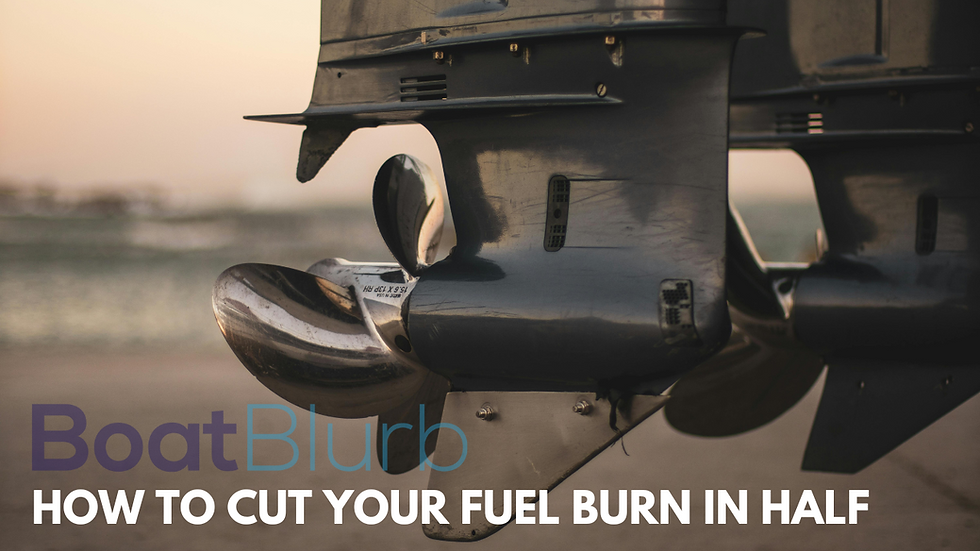
A properly matched propeller can significantly improve efficiency by allowing the engine to operate within its optimal RPM range.
Engine trim also matters. Running the engine too low or too high can increase drag and waste fuel.
Keeping the hull clean is another major factor. Marine growth or rough bottom surfaces can increase drag dramatically.
Finally, speed has one of the biggest impacts. Dropping just a few knots below maximum cruise can often reduce fuel consumption noticeably.
Estimating Your Boat’s Fuel Burn
If you want a quick estimate for your own boat, start with three numbers:
Total engine horsepower
Your typical cruising speed
Your approximate throttle percentage
Use the rule of thumb:
Horsepower ÷ 10 = gallons per hour at full throttle
Then reduce that number to roughly 60–70 percent for a realistic cruising estimate.
For most recreational boaters, this simple calculation gets surprisingly close to real-world fuel burn.
Final Thoughts
Fuel consumption can seem complicated, but the fundamentals are straightforward. Horsepower, hull design, and cruising speed determine most of the equation.
By understanding a few basic principles and using a simple rule of thumb, boaters can estimate fuel burn well enough to plan trips, manage fuel costs, and better understand how efficiently their boat operates.
You may not know the exact number without onboard instrumentation, but with the right framework, you will never be guessing blindly again.


Comments