
2,000-Year-Old Roman-Era Pleasure Barge Reveals Earliest Evidence of Recreational Boating


The Roman-era "pleasure barge" offers a rare glimpse into the earliest era of recreational boating in human history.
Marine archaeologists working off the coast of Alexandria, Egypt have uncovered the remarkably intact remains of a 2,000-year-old Egyptian pleasure barge.
The discovery marks one of the earliest known discoveries of a recreational boat designed for recreation rather than economics.
The incredible find is a glimpse into the beginnings of 'luxury boating' when civilizations began to accrue enough wealth to build vessels designed for leisure rather than industry. It also provides insight into vessel construction and marine engineering during the early Roman period. The vessel — the first of its kind found in Egypt — was built during a time when Alexandria served as one of the Mediterranean’s busiest and most advanced maritime hubs.

The vessel, translated loosely as a 'pleasure barge,' is referred to in texts as a thalamegos -- or ceremonial pleasure craft -- and was located near the submerged island of Antirhodos in Alexandria’s historic Portus Magnus. The area is long known to contain the remains of collapsed palaces, temples, and harbor infrastructure that were gradually buried as the region expanded and progressed. The coastline has also been deeply affected by temperamental geography -- tsunamis, storms, and volcanic activity have damaged and destroyed areas of the coastline since before recorded history. The excavation, led by renowned underwater archaeologist Franck Goddio and the European Institute for Underwater Archaeology (IEASM), uncovered the ship. Their research linked historical descriptions of thalamegos vessels to the vessel they found, which has never been physically documented in Egypt before.
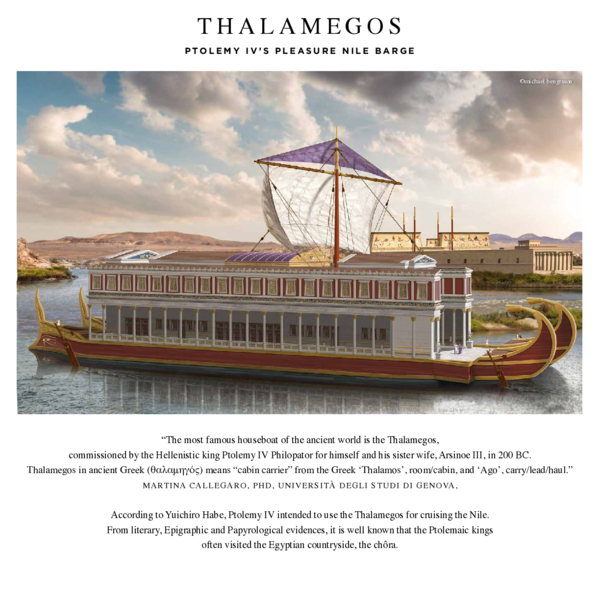
The vessels are described in Egyptian texts as "palace barges" or "floating palaces." The Egyptian pharaoh Ptolemy II Philadelphus, who ruled from 284 to 246 BC, was said to have '800 thalamegoi' at his disposal which could be used for cruising the Nile for government business, religious ceremonies, and social and cultural events. Cleopatra VII also used a thalagamos to show Julius Caesar the sights of Egypt in the spring of 47 BC.
The wreck found at Antirhodos measures approximately 35 meters (115 feet) long with a beam of 7 meters (23 feet) and utilizes more than 28 meters (91 feet) of continuous hull planking -- an exceedingly rare detail about ancient boatbuilding and the lumber used to craft them. Its hull is flat-bottomed and wide, suggesting it was engineered for low-draft maneuvering in calm inland waters rather than offshore navigation — another detail that matches with its presumed role in ceremonial or leisure operations along Alexandria’s canals and harbor.
According to the Greek City Times, the ship’s central carling beam even contains Greek graffiti, which researchers dated to the first half of the 1st century AD. The discovery of ancient graffiti not only confirms the vessel’s local construction but also gives insight into the cultural and social environment in Alexandria under Roman rule.

Maritime historians also say the discovery is especially significant because it matches first-century descriptions from Greek geographer Strabo, who visited Alexandria around 29-25 BC and wrote about large luxury barges “luxuriously fitted out and used by the royal court for excursions and the crowd of revelers who go down from Alexandria by the canal to the public festivals; for every day and every night is crowded with people on the boats who play the flute and dance without restraint and with extreme licentiousness.” The boat's technical dimensions, layout, and engineering all seem to match his descriptions.

Franck Goddio, a visiting professor in maritime archaeology at the University of Oxford, told The Guardian, “It’s extremely exciting because it’s the first time ever that such a boat has been discovered in Egypt … Those boats were mentioned by different ancient authors, like Strabo, and they were also represented in some iconography – for example in the Palestrina mosaic, where you see such a boat of a much smaller size with noblemen hunting hippopotamuses. But [an actual boat] has never been discovered before.”

Based on the ship's hull design and the historical context, archaeologists believe the vessel was oar-powered, rather than sailed, and required a rowing crew of more than 20 oarsmen. The ship's broad central section also suggests it featured a large pavilion -- an area built for lounging, entertainment, and ceremonial display — characteristics that make it uniquely designed for leisure rather than economy. “The bow is flat … and the stern is round … to be able to navigate in very shallow water," added Goddio.
#/media/File:Brogi,_Giacomo_(1822-1881)_-_Pompei_-_Tempio_d'Iside_-_n._5038_-_ca._1870.jpg)
To further support its use as a pleasure craft, the boat was also found near the remains of the Temple of Isis, which sits within the lost city of Pompeii. Researchers believe the vessel may have played a formal role in the Navigatio Iside, an annual maritime festival celebrating Isis as the goddess of the sea.
Archaeologists estimate the ship sank around 50 AD, perhaps during one of the seismic events that destabilized the harbor over the centuries, including the famous lost city of Pompeii which was covered under volcanic ash after the eruption of Mount Vesuvius in 79 AD. Throughout history, much of ancient Alexandria’s waterfront was collapsed during earthquakes and tsunamis. In several recorded instances, natural events pushed entire palace complexes, docks, and coastal infrastructure into the sea. Ironically, that same precarious environment also preserved ship timbers remarkably well, making them identifiable when discovered centuries later.
For the time being, the thalamegos will remain in situ under UNESCO preservation standards while teams of archaeologists conduct more excavations and research -- giving them rare access to ancient hull building techniques, timber selection, carpentry style, and engineering that was developed by early Roman-era Egyptian shipwrights.
The ship also stands as one of the earliest examples of pleasure boating ever recorded in human history. #news #culture


Comments