
The Yachts Behind the Names — Part I


Many of the world's largest private superyachts are owned by Middle Eastern royalty and Russian oligarchs. There are so many privately owned superyachts in the world that the list is seemingly endless, but there are several, thanks to their prominent owners or the unique nature of the vessels themselves, that show just how far yacht design can go when the usual rules of size, cost, and practicality are largely left at the dock.
But first, some clarification. The terms yacht, superyacht, megayacht and now even gigayacht are often used interchangeably, and none has a universally accepted definition. For the purposes of this series, the following definitions based on overall length are generally accepted:
Yacht – 40 to 80 feet (12 to 25 m)
Superyacht – 80 to 200 feet (25 to 60 m)
Megayacht – 200 to 300 feet (60 to 90 m)
Gigayacht – over 300 feet (90 m)
These are not hard-and-fast rules, but they are generally used as a rough guide. The conversion between feet and metres is somewhat generalized for ease of use. “Gigayacht” is also a relatively new term and one that many, myself included, don't use. For those of us who are still old school, anything over 200 feet is a megayacht.
So here we go. Rather than starting small and working our way up to the biggest yachts, I’ve decided to mix together some of the largest and smallest superyachts and megayachts belonging to famous names from stage and screen, business and sports — people you will likely recognize and whose yachts you might want to know more about.
David Geffen
#/media/File:Rising_Sun_Yacht.JPG)
The first name I recognized on the master list of the world’s largest yachts was that of entertainment executive, record producer, and film producer David Geffen, whose megayacht (okay, gigayacht), Rising Sun, is 453 feet (138 m) long and sits at number twenty on that list.
It was originally designed for Larry Ellison, champion sailor, co-founder and CEO of Oracle Corporation, and a multi-time sponsor of America’s Cup racing. It was delivered by German builder Lürssen in 2004. Rising Sun can accommodate eighteen guests in nine cabins and a crew of forty-five. It has a helipad and five decks featuring a basketball court, gymnasium, movie theatre, wine cellar and large swimming pool.
But perhaps the most distinctive feature of Rising Sun is its enormous expanses of glass. The yacht's curved window panels were so ambitious that sourcing suitable materials became a worldwide search and specialized heat-insulating film had to be incorporated into the glass to reduce the energy required for air conditioning. The vessel was designed by legendary yacht designer Jon Bannenberg, who is often cited as the father of modern yacht design, and was his last project.
Rising Sun has a top speed of 35 mph (56 km/h) and a cruising speed of 30 mph (48 km/h). David Geffen has owned it since 2010, and it is said to be worth around $400 million USD.
Roger Samuelsson
#/media/File:Octopus_Yacht_by_Taha%E2%80%99a,_French_Polynesia_(June_2026).jpg)
I am including this unique megayacht not because its current owner is necessarily a household name — he probably isn’t — but because the Lürssen-built Octopus was originally delivered in 2003 to Microsoft co-founder Paul Allen, a name most would certainly recognize. Current owner Roger Samuelsson is a Swedish entrepreneur who owns the largest share of Switzerland-based SHL Medical, said to be the world’s largest maker of autoinjectors.
Octopus has eight decks, including a private owner’s deck, accommodation for twenty-six guests in thirteen staterooms, and room for a crew of sixty in thirty cabins. It has an aft-deck helipad, another helipad on the foredeck, a hangar, and accommodation for seven tenders and two submarines, one of which is a remotely controlled deep-diving vessel.
Octopus, not to be confused with the much smaller 143-foot Bond-named superyacht Octopussy, features several bars, multiple lounges, a spa, cinema, gymnasium, library, basketball court, and swimming pool.
Perhaps the most remarkable feature of Octopus, however, is hidden inside the yacht. Its stern opens into a two-level floodable dock designed to launch and retrieve its large tender, submarines and other watercraft. Placing the dock along the centreline was an engineering solution to a basic stability problem: launching heavy equipment over the side could cause the yacht to heel. Instead, the designers created what amounts to a private marina inside the yacht itself.
In 2015, while on loan to the Royal Navy, its remote-controlled submarine (ROV) was used to recover the ship’s bell from the British warship HMS Hood, which was sunk in World War II by the German battleship Bismarck in 9,000 feet of water in the Denmark Strait, with the loss of 1,400 lives.
Patrick Dovigi

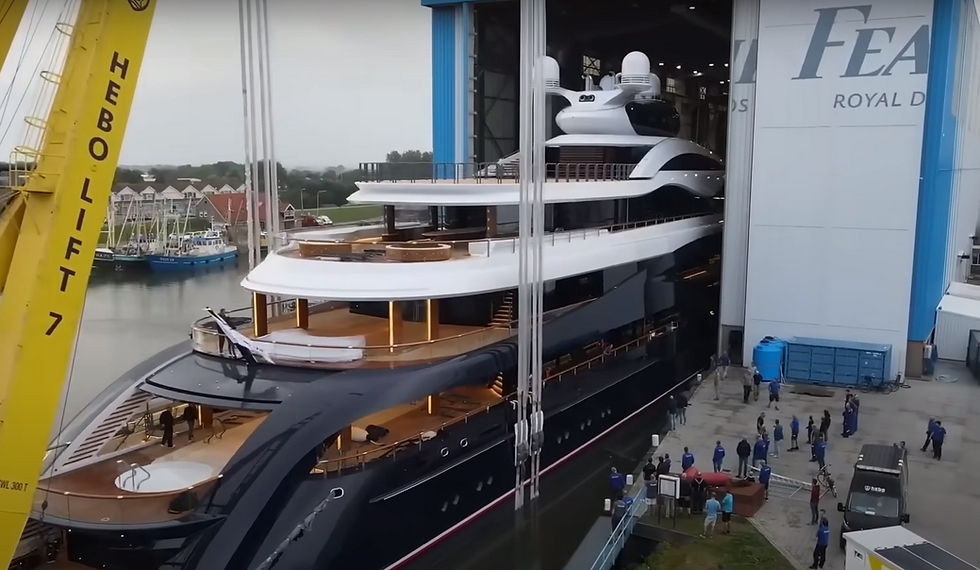
Here’s another owner who is not a household name by any stretch but who owns a megayacht of immense renown. Built by Holland’s renowned Feadship, Breakthrough was delivered to its owner, Microsoft co-founder Bill Gates, in May 2025. It is number 37 on the master list of the world’s largest yachts. It is said that Gates never set foot on board. The vessel immediately went up for sale.
This revolutionary megayacht was purchased by Canadian Patrick Dovigi, founder and CEO of waste management and environmental services company Green For Life Environmental Inc. And Breakthrough fits that mantra to a tee. It is the world’s first “green” superyacht or megayacht powered by hydrogen fuel cells, allowing it to cruise short distances emissions-free. The hydrogen is stored onboard cryogenically at -253˚C (-423˚F). The fuel cells also work on methanol.
There are also hybrid biofuel diesel-electric generators for backup and long-distance cruising. Power is delivered through a pair of ABB Azipod gearless, electric, 360˚ steerable pods. Maximum speed is 20 mph (31 km/h).
One of the more unusual design features is hidden in the hull itself. Breakthrough has fourteen concealed balconies that slide outward at the touch of a button, transforming what appear to be uninterrupted sections of hull into private outdoor spaces. Seven additional unfolding platforms provide direct access to the water.
Mark Zuckerberg

Here’s an owner whose name we all readily recognize. Launchpad may be number 39 on the list of the world’s largest yachts, but until Bill Gates ordered Breakthrough, Mark Zuckerberg’s yacht was, for a few months, the largest yacht ever built by Holland’s Feadship. Zuckerberg, Facebook co-founder and chairman, CEO and controlling shareholder of Meta Platforms, took delivery of Launchpad in 2024.
At 387 feet (118 m), this Feadship is only 3 feet (1 m) shorter than Breakthrough, which was ordered by Bill Gates and delivered a year later. Said to have cost in the neighbourhood of $300 million USD, Launchpad offers accommodation for twenty-six guests in thirteen staterooms, plus room for a crew of forty-nine.
Said to be powered by four MTU diesels producing a total of almost 24,000 hp, it is capable of cruising at just under 20 mph (32 km/h), with a top speed of 28 mph (45 km/h). According to Feadship, it features a “fully enclosed pod-like observation lounge on the top deck” with “curved glass windows.” It also offers a gymnasium, spa, swimming pool with a moveable floor, salon, beach club, and private owner’s deck with whirlpool.
At 263 feet (80 m), Zuckerberg’s support vessel Wingman is a megayacht in its own right. It offers room for an additional eight guests in four cabins and houses a crew of twenty-six. It accompanies Launchpad everywhere, carrying supplies and tenders of all sorts for all purposes.
What really sets this pair apart is the relationship between the two yachts. Wingman isn't simply a second luxury yacht; it was built to support Launchpad and carries the equipment that allows the larger yacht to operate far beyond the capabilities of a conventional superyacht. With a helicopter, submarine, multiple tenders and even a decompression chamber for deep diving, the 263-foot support vessel effectively acts as a floating equipment depot for its 387-foot mothership.
To assist in its duties, Wingman has a deck crane, at-anchor stabilizers, spa, sauna, steam room, massage room, gymnasium and hospital. It offers 360-degree visibility from the bridge helm. Wingman is said to have cost around $30 million USD.

Wingman / Photo - Michael Townsend-Harmony 
Wingman / Photo - Michael Townsend-Harmony
Max Verstappen

Earning a reported $60 million USD last year, four-time Formula 1 World Champion Max Verstappen took delivery of this Italian-built, $15 million, 33.3-metre Mangusta Gransport 33 superyacht in 2025. Powered by four Volvo Penta D13 diesels producing a total of about 4,000 horsepower, with an IPS pod propulsion system and joystick control, the all-fiberglass Unleash The Lion cruises at 21 knots (24 mph; 39 km/h), with a top speed of about 25 knots (29 mph; 47 km/h).
It can accommodate twelve guests in five staterooms, plus five crew, including the captain, in three cabins. Verstappen’s owner’s stateroom is over 400 square feet (40 sq. m). The raised foredeck is the social gathering spot, with a sunpad, settee, and hot tub.
For a yacht of this size, one of its more practical design features is its shallow 1.9-metre (6.2-foot) draft. That gives Unleash The Lion access to shallow bays and anchorages that can be off-limits to much larger superyachts, adding a measure of versatility to a vessel designed as much for performance as for luxury.
Billy Joel
To bring us back to earth, one of the world’s best-selling music artists, singer, songwriter and pianist, nicknamed “The Piano Man” and a member of the Rock & Roll Hall of Fame, Billy Joel’s stunning 57-foot (17 m) Vendetta was built by Derecktor Shipyards of New York in 2005 and refurbished in 2019. At 57 feet, Vendetta is considerably smaller than the yachts featured above, but its celebrity ownership and distinctive design make it an interesting counterpoint to their enormous scale.
Custom-designed for Joel, Vendetta was built to get him around Long Island Sound and New York City. Its pair of MAN diesels, totaling 1,300 hp, allow it to cruise at 40 mph (64 km/h) and reach a top speed of more than 50 mph (80 km/h). Following its 2019 refit as an offshore day cruiser, it is now equipped to carry a dozen guests in luxurious cockpit seating. Its new anonymous owner subsequently moved the boat to Newport Beach, California.
What makes Vendetta particularly interesting is the contrast between its appearance and its engineering. Its long, low profile were deliberately inspired by the commuter yachts that carried wealthy Long Island residents to Manhattan during the '20s and '30s, while its lightweight composite hull and surface-drive propulsion system are thoroughly modern. The result is a yacht that looks like it belongs to another era but was engineered for modern performance.
The yachts featured here represent only a fraction of the remarkable vessels owned by recognizable names. Part II will look at more, including yachts belonging to Steven Spielberg, David Beckham, Eric Clapton and others.
There is no single formula for building an extraordinary boat. Sometimes it is sheer size, sometimes speed or technology, and sometimes it is a singular design detail that makes a vessel unlike anything else afloat. Ultimately, they show just how far yacht design can go when the usual rules are left at the dock. #culture



Comments