
Edmund Fitzgerald Relics Fetch $150,000 as Historic Life Ring, Lifeboat Piece Go to Auction

Updated: Jan 2

Two rare relics from one of the Great Lakes’ most enduring maritime tragedies sold for a remarkable $150,000 at an auction in downtown Detroit last week, one month after the 50th anniversary of the sinking of the iconic SS Edmund Fitzgerald. The auction drew intense interest from boaters, history buffs, and collectors alike, driving up the bidding far beyond what the auctioneers and the owners were expecting.
An orange life ring marked “S.S. Edmund Fitzgerald” and a weathered wooden plank believed to be from one of the ship’s lifeboats were the keynote items at the DuMouchelles Auction House after more than a week of online bidding. The plank, believed to be from Life Boat No. 1, bears the words "No. 1" in black paint with dimensions matching the lifeboat's size. The plank measures 4" tall and 50.5" inches long.
Boaters and Great Lakes historians know the plight of the SS Edmund Fitzgerald well, her sinking in 1975 not only being lionized by folk singer Gordon Lightfoot, but also as a signature part of popular maritime culture. She remains the largest shipwreck in Great Lakes history. The 729-foot ore carrier was loaded with 26,000 tons of taconite pellets when she sank in a ferocious storm near the infamous Whitefish Bay on Lake Superior, claiming the lives of all 29 crewmen aboard. It's believed the dangerous 'November gale' synonymous with the worst Great Lakes' storms brought winds over 100 mph, 35-foot waves, and a blinding snowstorm that broke the ship in two. While the exact cause of the sinking has never been truly satisfied, the loss of 'The Big Fitz' remains a defining moment in Great Lakes history and a symbol of the underrated power of the lake system, particularly their propensity for sudden onset storms.
The life ring and lifeboat plank were found by Larry Orr, now 77, on a remote stretch of Michigan’s Upper Peninsula shoreline eight days after the disaster in 1975. Both pieces spent years on display at the Great Lakes Shipwreck Museum in Paradise, Michigan, before being consigned to auction this month.
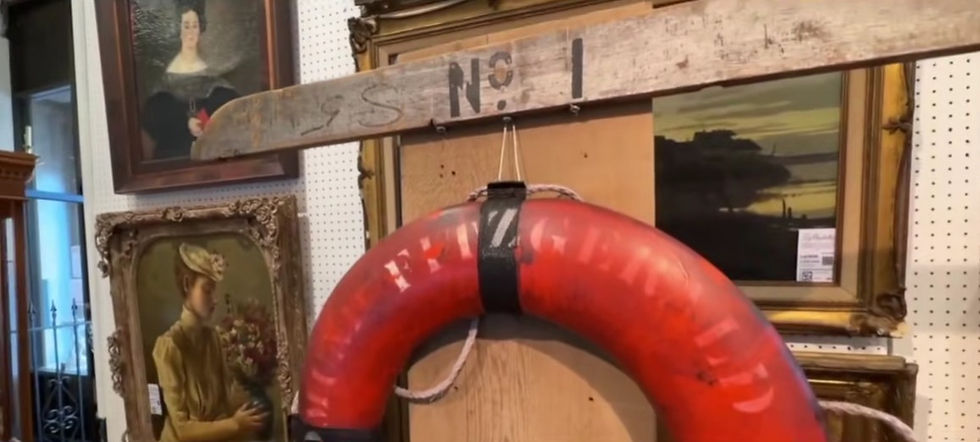
“I’m dumbfounded,” Orr said after the sale. “I never believed in a million years it would go for that much money. Shocked.” He has lived with the memories of that discovery since he was a young carpenter, a moment he described as eerie and unforgettable.
Auctioneer Robert DuMouchelle, general manager of DuMouchelles, emphasized the significance of the pieces leading up to the auction. “It’s a part of maritime history, U.S. history,” he told local media as bidders gathered at the historic venue.
"We did think it was going to take off, but, of course, this far exceeded my expectations," added DuMouchelles. "You never know though."
According to the auction site catalog, the two items were expected to fetch a combined $15,000 to $20,000 USD. When the auction went live, the price went from $40,000 to $150,000 in four minutes.
Some who attended the auction questioned why such important artifacts were sold in a private setting rather than remaining in a museum collection.
"This is always something that a museum would be picking up, and to be in a public auction is really quite unique," bidder Rich Williams, who traveled from Grand Rapids, told Fox 17 West Michigan.
Another bidder, Roger Wensen from Detroit, was equally surprised. "You'd think something like that would have been put into a museum or something," Wensen told Fox 17.
For decades, Orr had permitted the Great Lakes Shipwreck Museum to exhibit the relics. But in recent months, he decided to sell, in part for financial reasons, and with the hope that the pieces might still return to public view in the future. “Ideally, I would like to see someone purchase it and loan it back, ideally to the Great Lakes Shipwreck Museum,” Orr said.
The auction’s timing — just over a month after the 50th anniversary of the Fitzgerald’s sinking — added extra emotional weight to the sale.
While the identity of the winning bidder will remain undisclosed, Orr and others are all hoping the relics will be entrusted to an institution or display that honors the legacy of the ship and her crew for generations to come.
In a strange twist, Orr had recently agreed to give the relics to the state of Michigan as part of a $600,000 US settlement in an unrelated misconduct lawsuit against state police, according to CBC. But Michigan state agreed to return them after The Associated Press exposed the strange deal.
The relics will now be transferred to the winning bidder, or bidders, with hope they'll remain on public display in a new location. #news #culture


Comments